Kyoto Is Easy to Attack and Difficult to Defend
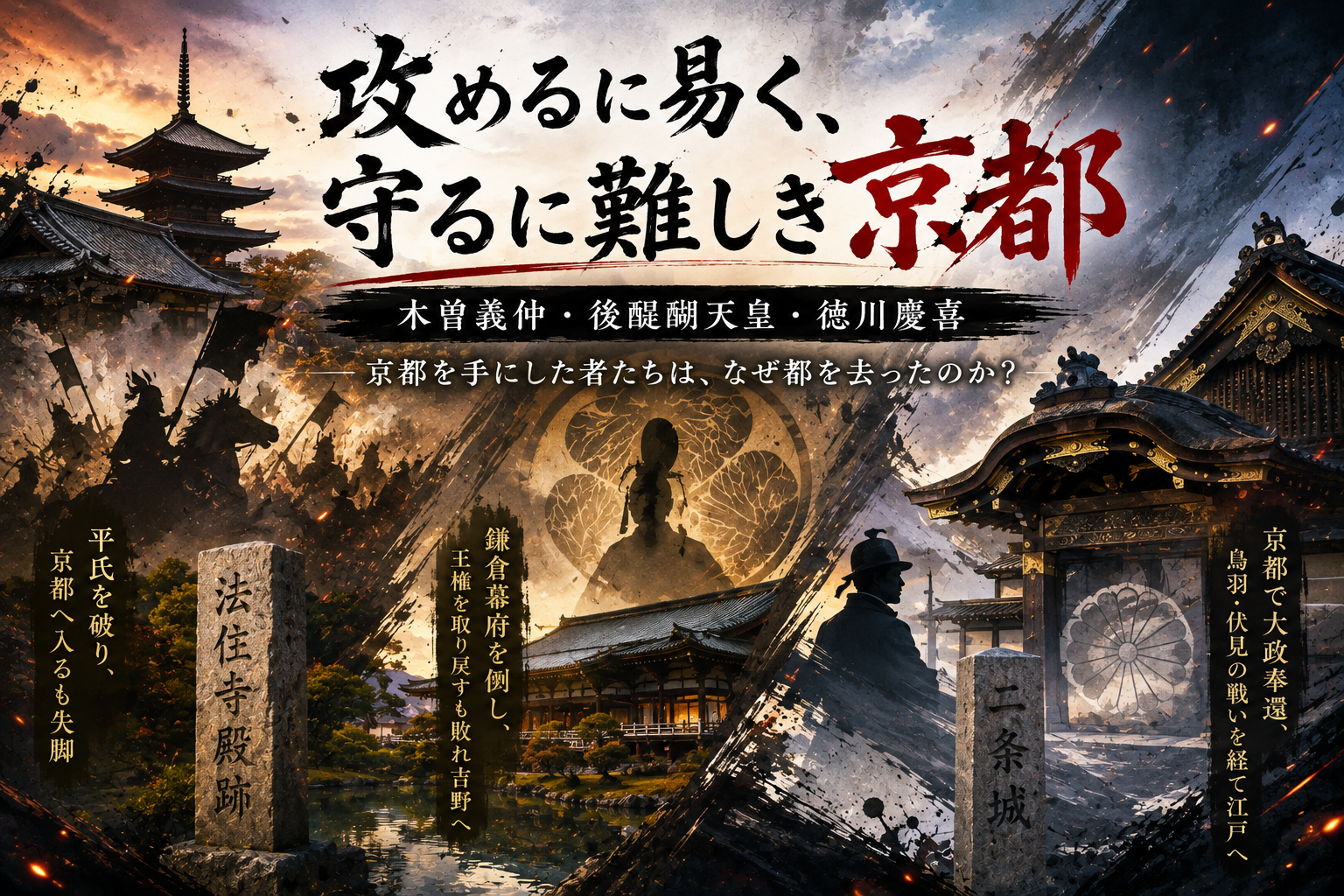
Kiso Yoshinaka, Emperor Go-Daigo, Tokugawa Yoshinobu — Why Did Those Who Held Kyoto Have to Leave It?
Kyoto has been sought by more rulers than perhaps any other city in Japanese history, and yet few of them managed to stay. Kiso Yoshinaka took the capital by force. Emperor Go-Daigo won back the throne's own authority within it. Tokugawa Yoshinobu made one of history's great political decisions on this very ground. And all three, in the end, left Kyoto behind. Why is holding Kyoto so different from taking it? Walk through three real places — Hōjūji, Tenryū-ji, and Nijo Castle — and trace the answer for yourself.
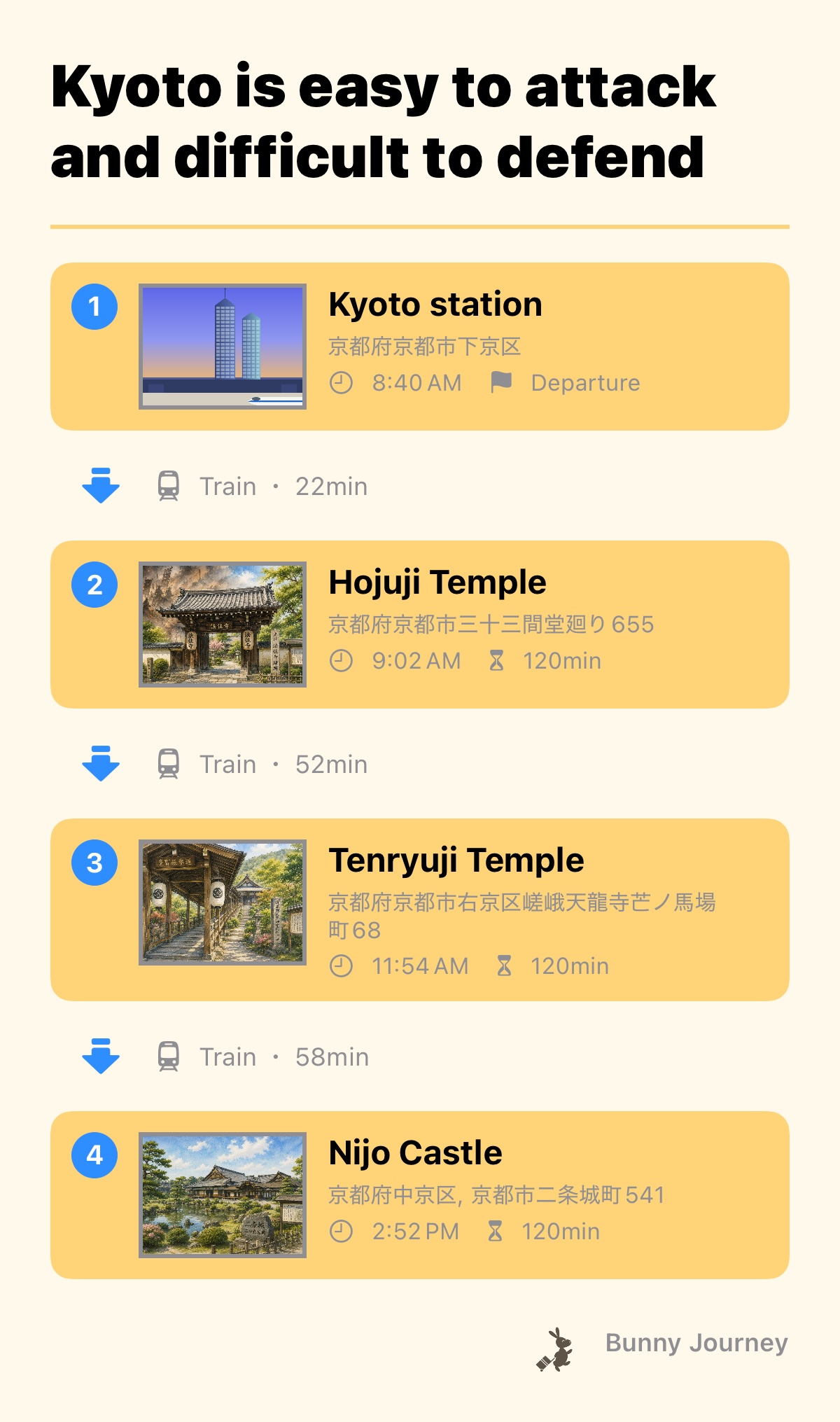
- Number of spots
- 3 spots
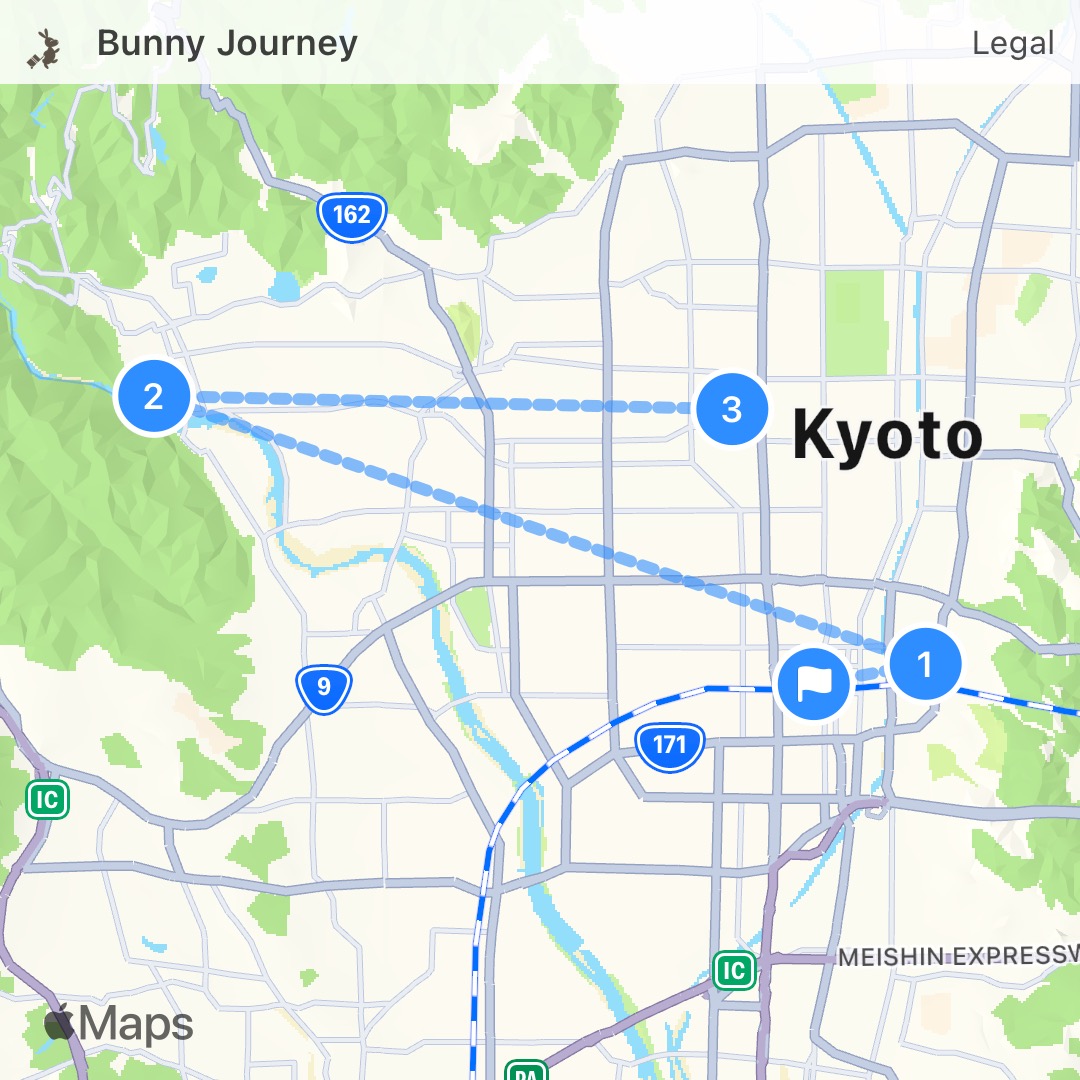
- Travel distance (approx.)
- approx. 15.8km
- Start point
- Hōjūji Temple
- End point
- Nijo Castle, Ninomaru Palace and Garden
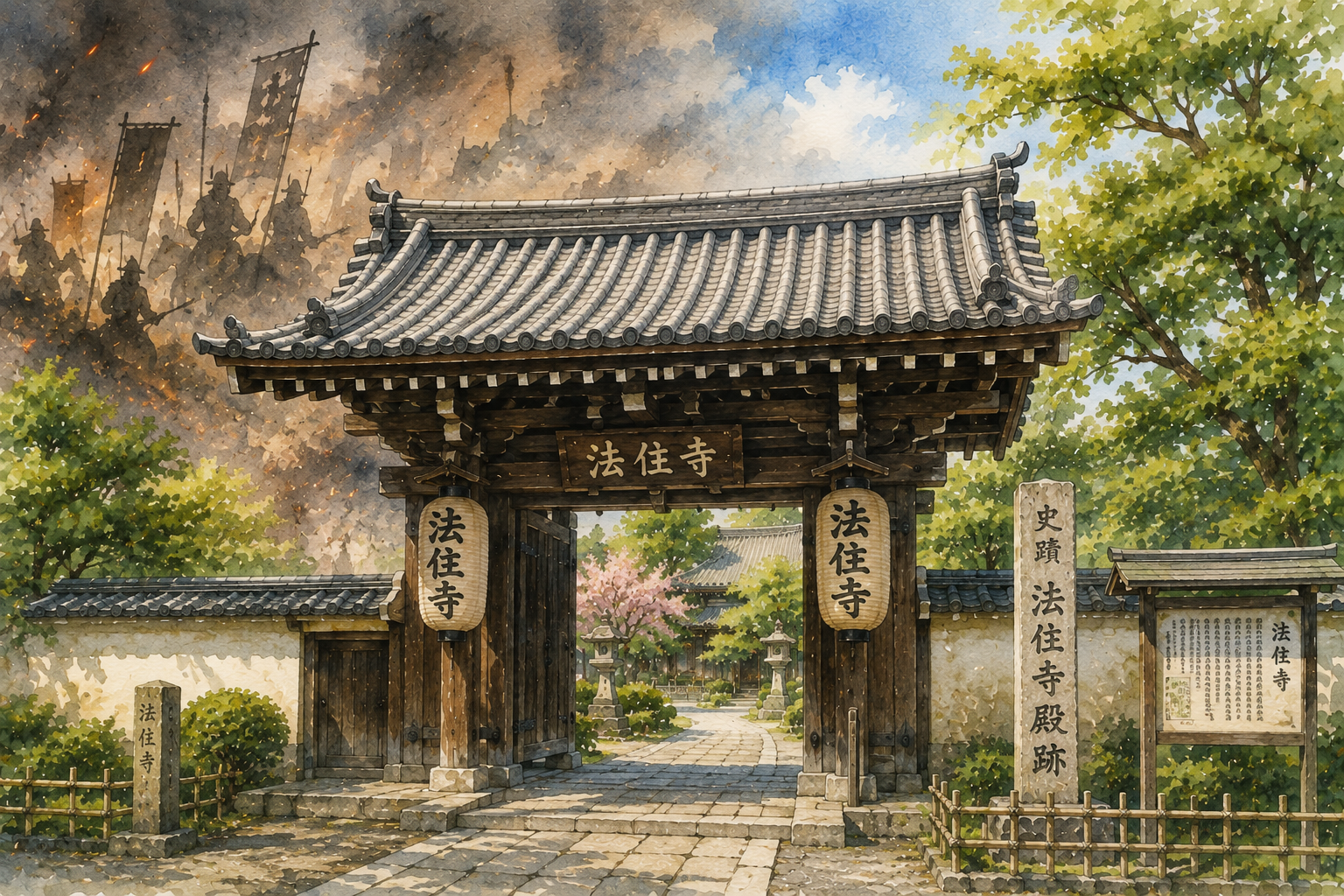
Hōjūji Temple
京都府京都市東山区三十三間堂廻り655
A small, quiet temple standing right beside Sanjūsangen-dō. A stone marker reading "Hōjūji-dono Ato" stands in the grounds, recording that this was once the site of the retired Emperor Go-Shirakawa's palace, Hōjūji-dono. The main hall enshrines a statue known as the "Migawari Fudō" (Substitute Fudō), which temple tradition holds took an arrow meant for the retired emperor during the Hōjūji Incident. Walking its calm grounds today, visitors can trace the site of an armed clash that once erupted in the heart of the capital.
Our journey begins at Hōjūji Temple. Kiso Yoshinaka had crushed a huge Taira army at Kurikara Pass and swept into Kyoto in triumph, but his own troops' lawlessness in the city quickly poisoned his relationship with the retired Emperor Go-Shirakawa. On the grounds of the retired emperor's former palace, Yoshinaka came face to face with the limits of ruling a city by force alone.
The Hōjūji Incident: Trust Lost in the Capital
After crushing a large Taira army at Kurikara Pass, Kiso Yoshinaka entered Kyoto in 1183. But his troops, left to their own devices in the city, repeatedly looted and terrorized residents, quickly costing Yoshinaka the trust of both the retired Emperor Go-Shirakawa and the people of the capital. Learning that the retired emperor was plotting to have him removed, Yoshinaka struck first at year's end, attacking Hōjūji-dono and defeating the retired emperor's forces himself — the Hōjūji Incident. Though he had seized the capital by force, the episode left him more isolated than ever at court, and he soon found himself hunted by an army Minamoto no Yoritomo had sent from Kamakura under Yoshitsune and Noriyori. The famous "fire-ox stratagem" said to have won the day at Kurikara Pass is a vivid tale recorded in war chronicles such as the Genpei Jōsuiki, but it is worth noting that its accuracy as historical fact is not firmly established.
Featured in this story: Kiso Yoshinaka
Next: Tenryū-ji, Tahōden Hall — a bit further out (about 9.2km as the crow flies). Taking a train or bus is recommended
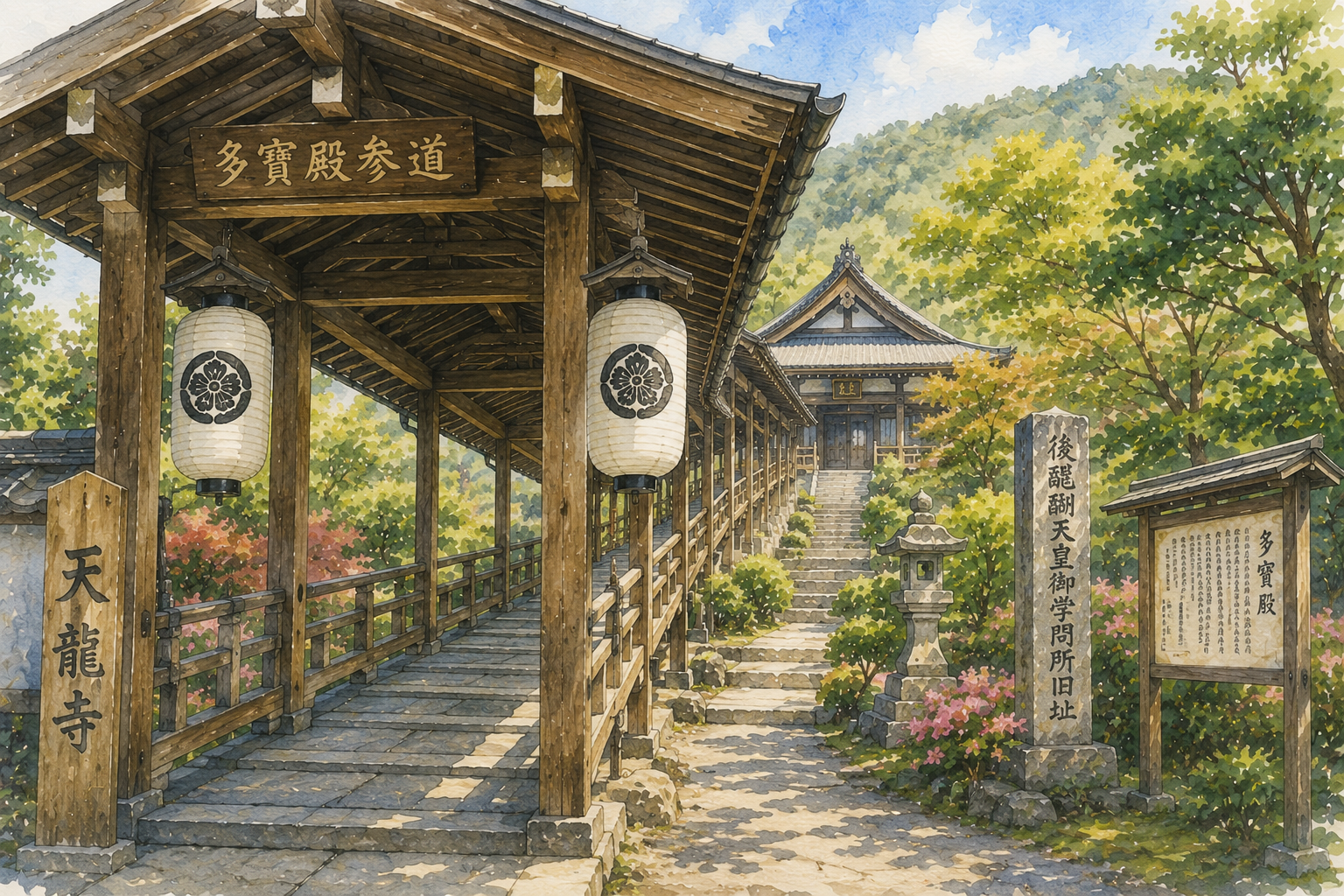
Tenryū-ji, Tahōden Hall
京都府京都市右京区嵯峨天龍寺芒ノ馬場町68
A covered walkway leading to the Tahōden hall, within the grounds of the World Heritage site Tenryū-ji. The temple was built by Ashikaga Takauji — on the advice of the Zen monk Musō Soseki — to console the spirit of Emperor Go-Daigo, who had died his political rival. The Tahōden enshrines a statue of Go-Daigo and continues to honor him to this day. The current Tahōden was rebuilt in 1934 and is not the original structure from Go-Daigo's own era, but the walkway still leads to the same place where the man who fought against him chose to pray for his soul.
Leaving Hōjūji, we head to the Tahōden hall of Tenryū-ji. Emperor Go-Daigo had brought down the Kamakura shogunate and reclaimed direct imperial rule, but he could not contain the samurai's anger over unequal rewards, and defeat at the hands of his former ally Ashikaga Takauji sent him fleeing to Yoshino. In a final twist, it was Takauji — the very rival he had fought — who later built this hall to console his soul.
The Kenmu Restoration, and an Exit from Kyoto
Having brought down the Kamakura shogunate, Emperor Go-Daigo began the Kenmu Restoration, ruling directly from Kyoto. But rewards for the fighting went disproportionately to court nobles rather than the samurai who had done the fighting, and discontent among the warriors rose fast. Even his former ally Ashikaga Takauji eventually turned against him, and in 1336 the emperor was defeated in battle in Kyoto and driven from the capital. Fleeing to Yoshino in Yamato province, Go-Daigo asserted his own claim to legitimate rule and founded a rival court — the Southern Court — standing alongside the Northern Court in Kyoto in what became the Nanboku-chō period. In a twist of history, it was Takauji himself, his one-time rival, who after Go-Daigo's death built Tenryū-ji to console his spirit, enshrining his statue in the temple's Tahōden hall.
Featured in this story: Emperor Go-Daigo
Next: Nijo Castle, Ninomaru Palace and Garden — a bit further out (about 6.5km as the crow flies). Taking a train or bus is recommended
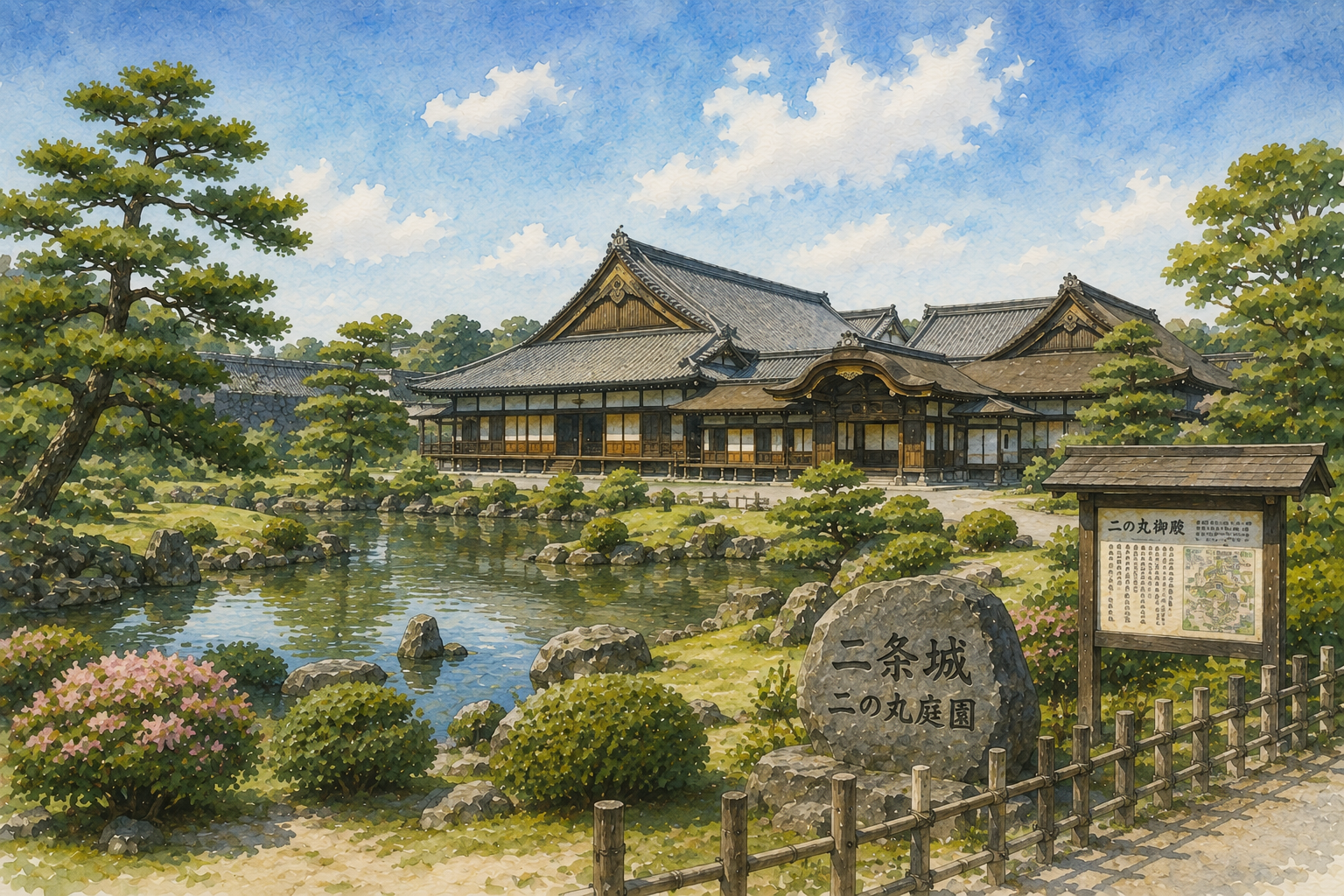
Nijo Castle, Ninomaru Palace and Garden
京都府京都市中京区二条城町541
Nijo Castle was built by Tokugawa Ieyasu as the shogunate's stronghold in Kyoto. The surviving Ninomaru Palace, a National Treasure, preserves its early Edo-period buildings almost as they were; it was in the Ohiroma reception hall of this very palace that Tokugawa Yoshinobu announced the Taisei Hōkan in 1867. The adjoining Ninomaru Garden, a strolling pond garden shaped since the same era, sits right beside it — so walking through the palace buildings and garden together means standing at the very place where 260-odd years of Tokugawa rule came to its end.
Leaving Tenryū-ji, we arrive at Nijo Castle. Tokugawa Yoshinobu announced here the Taisei Hōkan, returning power to the Emperor — but the decision alone could not settle the power struggle within the new government, and defeat at the Battle of Toba–Fushimi sent him fleeing Kyoto and Osaka for good. Here, 260-odd years of Tokugawa rule came to their end.
From the Taisei Hōkan to the Battle of Toba–Fushimi
In October 1867, Tokugawa Yoshinobu gathered senior retainers from across the domains in the Ninomaru Palace at Nijo Castle and announced the Taisei Hōkan, returning political authority to the Emperor. This nominally ended 260-odd years of Tokugawa rule, yet the struggle for control of the new government only deepened. In January 1868, former shogunate forces clashed with the new imperial army south of Kyoto at Toba and Fushimi — the Battle of Toba–Fushimi. As his side fell into an early disadvantage, Yoshinobu quietly abandoned his own troops at Osaka Castle and sailed back to Edo by warship. With this battle, the era of Tokugawa political control over the Kyoto–Osaka region effectively came to an end.
Featured in this story: Tokugawa Yoshinobu
Walk Kyoto, and You Can See the Roads Its Losers Took.
At Hōjūji, the trust Yoshinaka lost. At Tenryū-ji, the bond between Go-Daigo and his rival Takauji. At Nijo Castle, the end of the Tokugawa era. Three different eras, three very different men — yet the same difficulty of holding on to Kyoto still comes through when you walk this ground today.
- A Battlefield Genius, Undone in the Capital Hōjūji Temple
- The Emperor Who Reclaimed the Throne, and His Flight From Kyoto Tenryū-ji, Tahōden Hall
- The Last Shogun's Decision, and a Retreat From Kyoto Nijo Castle, Ninomaru Palace and Garden
This journey is ready to use in the app
We're sharing a file with all the spots and schedule from this article. Download it and import it from the "Schedule" tab in the Bunny Journey app to take this journey with you.
* If you don't have the app yet, install it from the App Store first.