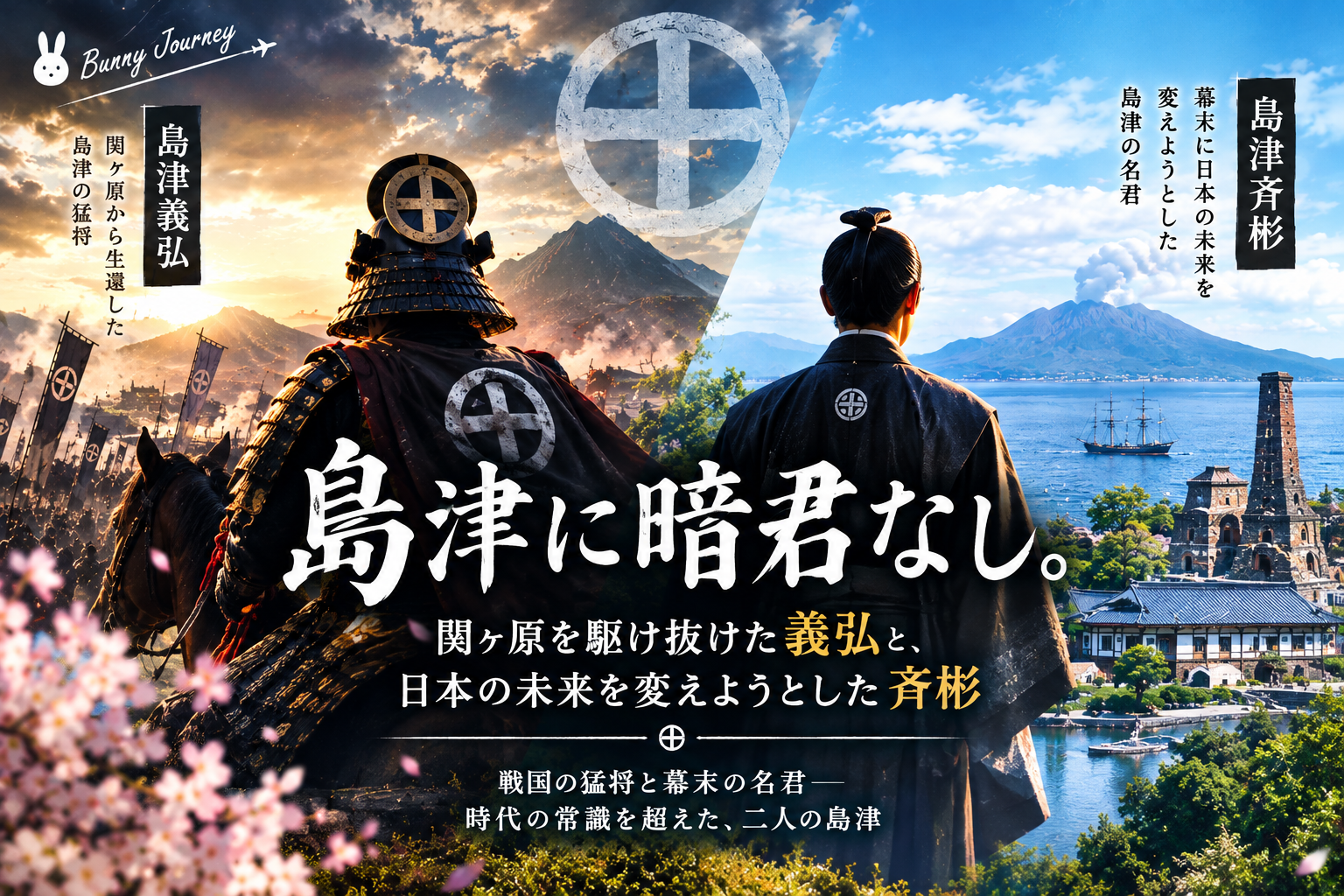
Why Is It Said the Shimazu Clan Never Had a Foolish Lord?
Shimazu Yoshihiro and Shimazu Nariakira — Tracing Two Uncharacteristic Decisions at Izaku Castle and Sengan-en
"The Shimazu never had a foolish lord." It's a phrase you hear often in Kagoshima, but dig into it and no clear source turns up for who first said it, or when. It reads less like an established historical judgment and more like a reputation that built up over a long time, passed along as popular wisdom. So instead of taking the phrase at face value, what if we looked at what these men actually decided to do? During the Sengoku period, on a battlefield at Sekigahara already lost, Shimazu Yoshihiro chose a breakthrough through the enemy's center instead of a retreat. About 250 years later, the Satsuma domain lord Shimazu Nariakira raced to adopt Western technology before any ship had even appeared off the coast — acting on nothing more than news of a war fought an ocean away. The two men lived in entirely different eras and fought in entirely different ways. What they shared was a refusal to make the obvious choice. Izaku Castle, where Yoshihiro was born, and Sengan-en, the ground where Nariakira staged his industrial gamble. Walk these two real places, and set out on a journey into what that old phrase actually means.
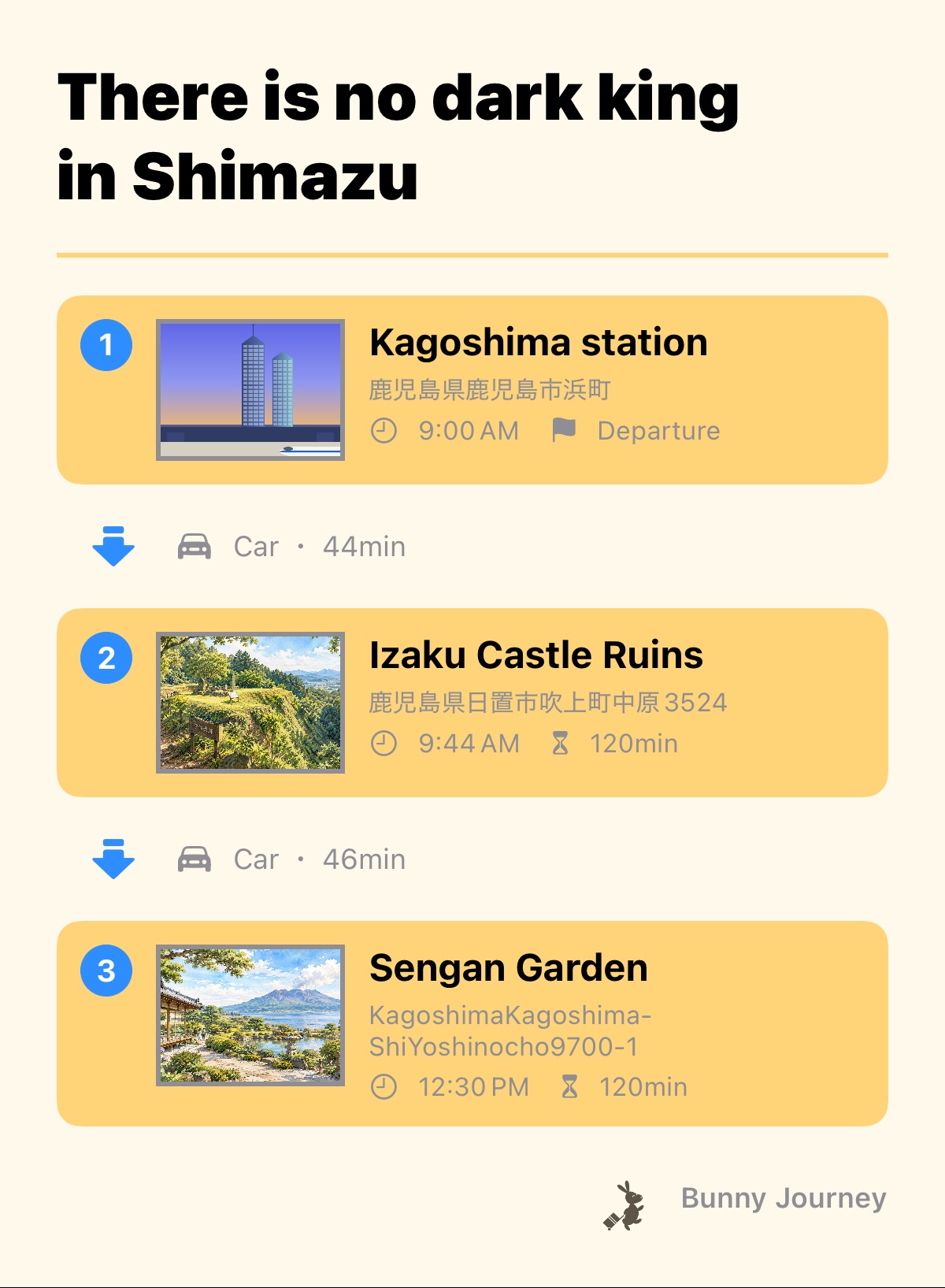
- Number of spots
- 2 spots
- Travel distance (approx.)
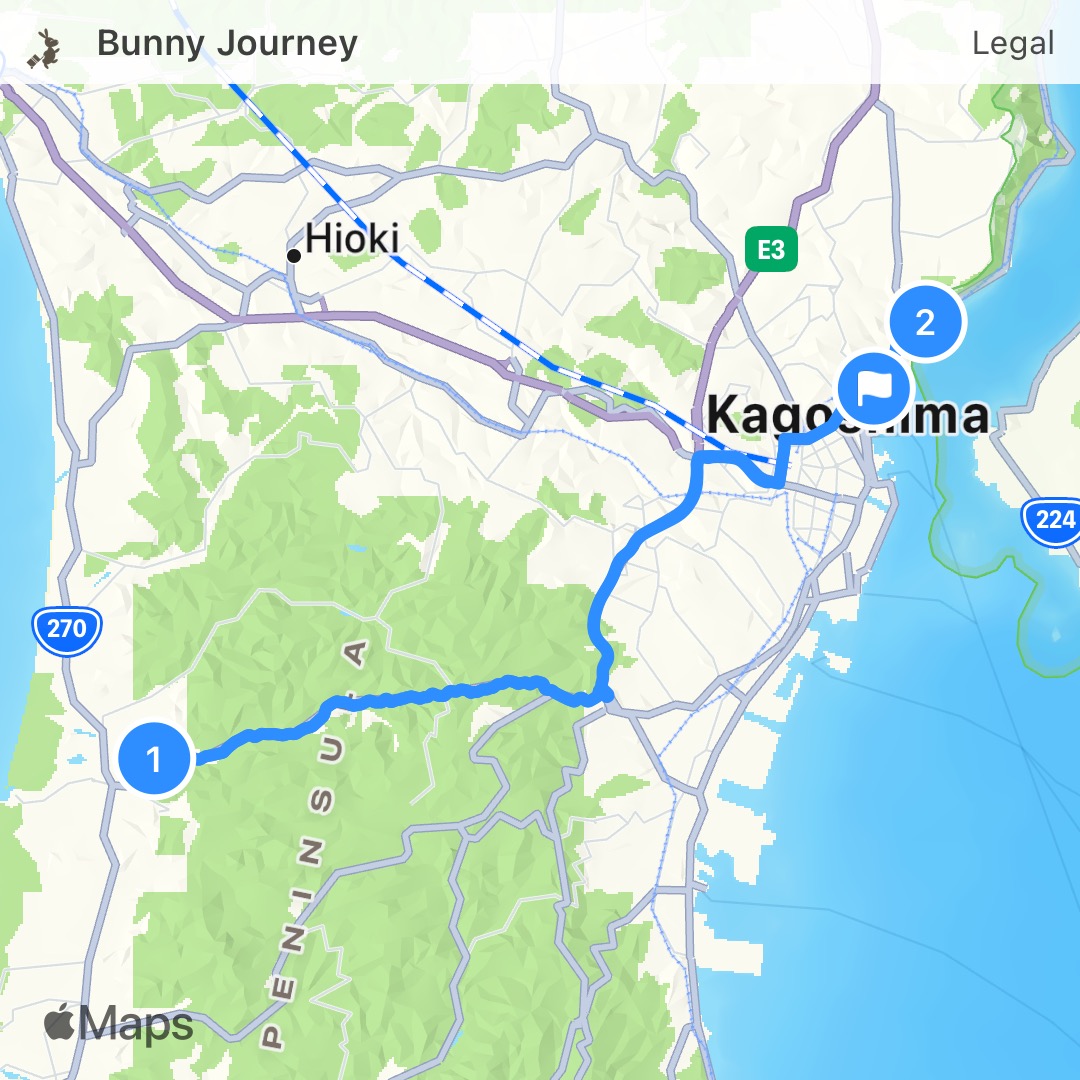
- approx. 22.7km
- Start point
- Izaku Castle Ruins
- End point
- Sengan-en
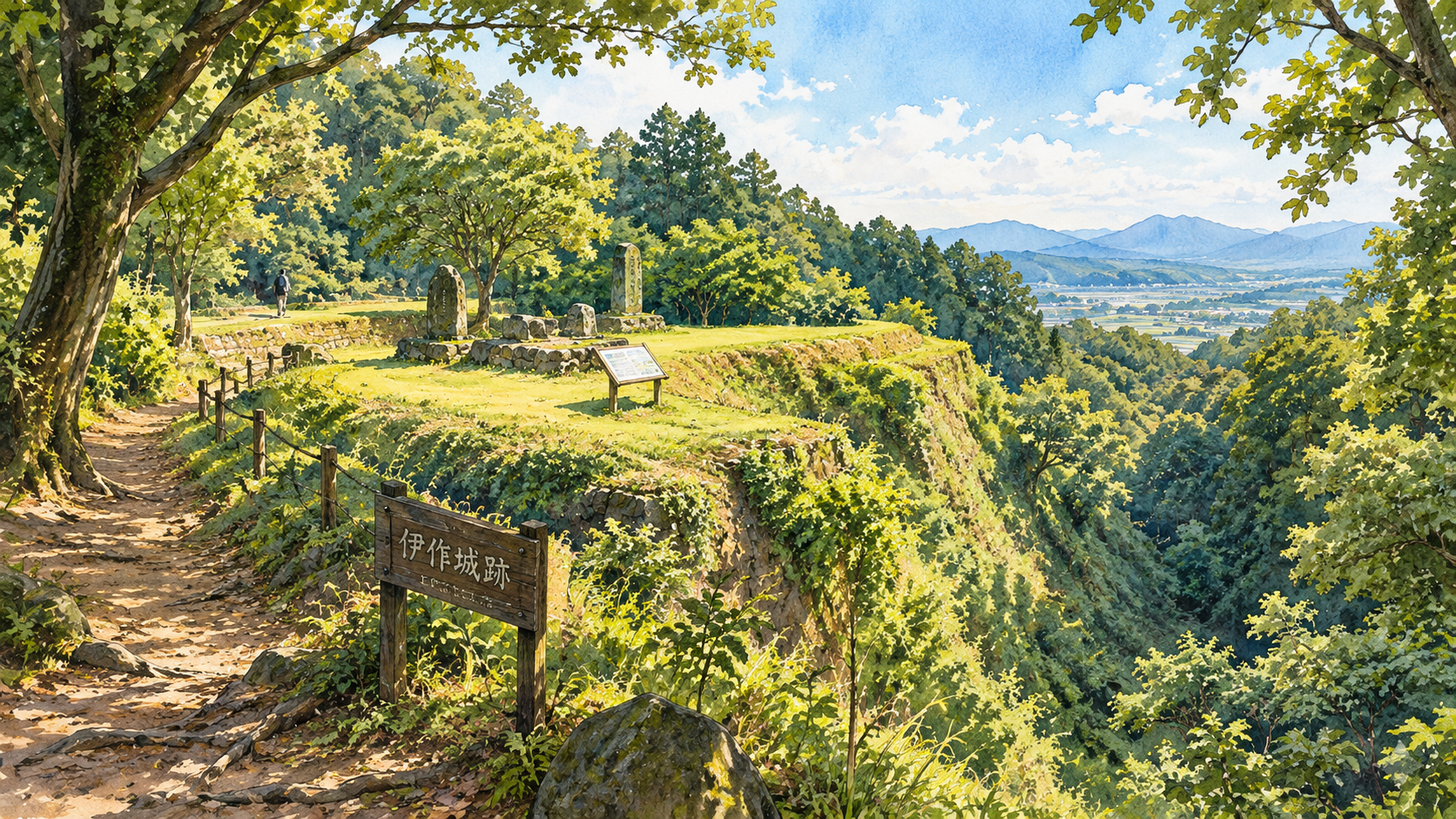
Izaku Castle Ruins
鹿児島県日置市吹上町中原3524
The ruins of the mountain castle of the Izaku clan, built during the Nanboku-cho period. It produced Tadayoshi (Jisshinsai), credited with reviving the main Shimazu line, and tradition holds that his grandson Yoshihiro and all three of his brothers were born within these walls. Birth stones marking the four brothers still stand in the main enclosure, Kamemaru Castle, and nearly 30 compounds separated by deep dry moats convey the scale of a true medieval mountain fortress. Well-maintained walking paths make it an easy visit, taking about an hour.
Our journey begins at Izaku Castle, about an hour's drive from central Kagoshima in Hioki City. At this mountain castle, built during the Nanboku-cho period, the four brothers who would carry the Shimazu clan through the Sengoku period — Yoshihisa, Yoshihiro, Toshihisa, and Iehisa — were born. Yoshihiro, in particular, would grow into the warlord feared as "Oni-Shimazu." Let's start here, where the Shimazu bloodline itself began.
Born at Izaku Castle, He Cut Through the Enemy at Sekigahara
In 1535, Shimazu Yoshihiro was born at Izaku Castle, the second son of Takahisa, the 15th head of the Shimazu clan. The birth stones still standing in the main enclosure, Kamemaru Castle, mark the births not only of Yoshihiro but of all four Shimazu brothers — Yoshihisa, Yoshihiro, Toshihisa, and Iehisa. It was this band of four brothers, working together, who carried the clan through the wars that unified Kyushu under Shimazu rule, laying the foundation for everything that followed. Yoshihiro is best remembered for the Battle of Sekigahara in 1600. It was Yoshihiro, not his elder brother and clan head Yoshihisa, who committed Shimazu troops to the fight. Fighting for the western army, he found coordination with his allies breaking down, and the Shimazu force saw almost no real combat before the battle tipped decisively toward the eastern army. What followed became known as the "Shimazu Withdrawal." For a force stranded on a collapsing battlefield, the obvious move was to retreat away from the enemy. Yoshihiro instead chose an unheard-of route: a direct breakthrough straight toward Tokugawa Ieyasu's own command post, cutting through the heart of the enemy lines. Accounts of troop numbers vary — figures for the force at the start of the retreat range from roughly 1,000 to 1,500, with some records putting the survivors at around 80 — and no single figure can be treated as confirmed. What every account agrees on is the sheer strangeness of the decision itself: advancing, not retreating, in the face of overwhelming odds. During that withdrawal, Yoshihiro's nephew Shimazu Toyohisa and his retainer Choju-in Morizumi, among others, held their ground against the pursuing enemy and were killed. This tactic — small groups staying behind to die so their lord could escape — became known as "sutegamari." It was on the sacrifice of many retainers that Yoshihiro finally made it back to Satsuma. Having backed the losing side at Sekigahara, the Shimazu clan stood in a position that could easily have ended in the confiscation of its domain. Instead, it survived. The fact that clan head Yoshihisa himself had not personally joined the fighting, Satsuma's remoteness from Kyoto and Edo, and persistent postwar negotiation are all cited as factors. That the clan came out of a defeat with its lands intact says something too — not just about one man's battlefield courage, but about the Shimazu clan's judgment as a whole.
Featured in this story: Shimazu Yoshihiro
Next: Sengan-en — a bit further out (about 22.7km as the crow flies). Taking a train or bus is recommended
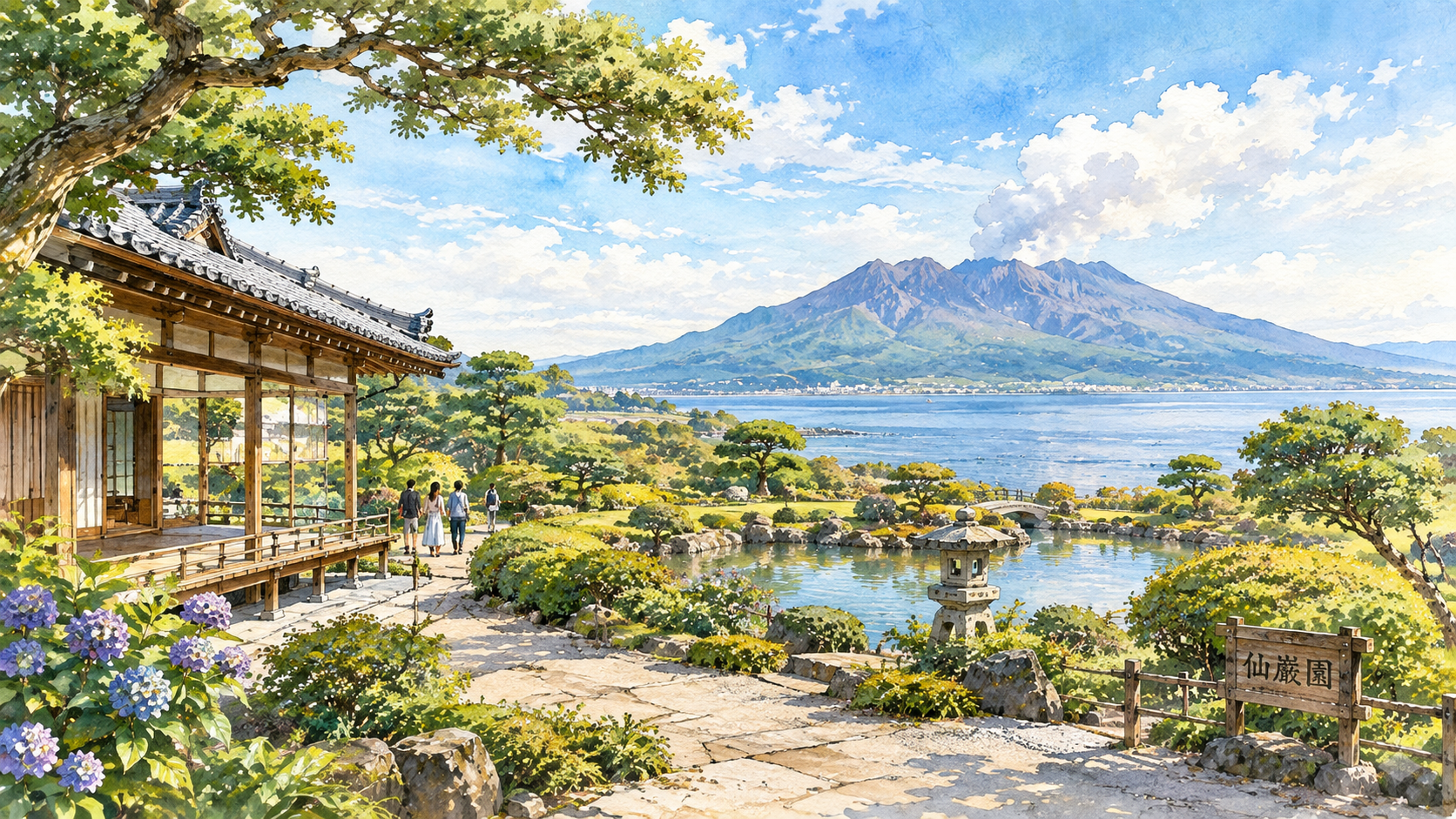
Sengan-en
鹿児島市吉野町9700-1
A Shimazu family villa built in 1658 by Mitsuhisa, the 19th head of the clan. It is known for its grand garden design, which uses Sakurajima as a borrowed backdrop and Kinko Bay as its pond. In the closing years of the Edo period, the 28th lord, Shimazu Nariakira, built a reverberatory furnace and a cluster of other factories just behind the estate — the Shuseikan enterprise, a pioneering step toward Japan's industrial modernization. The furnace ruins are part of the UNESCO World Heritage Site "Sites of Japan's Meiji Industrial Revolution," and the adjacent Shoko Shuseikan museum covers the history in depth.
Leaving Izaku Castle, it's about an hour's drive to Sengan-en, and the scene shifts to the final years of the Edo period. About 250 years after Yoshihiro's time, the Shimazu clan faced a crisis of an entirely different kind — not the chaos of civil war, but the Western powers arriving from across the sea. What answer did the 28th clan head, Shimazu Nariakira, choose on the ground just behind this garden?
Before the Black Ships Arrived, Nariakira Was Already Moving
Sengan-en itself was not Nariakira's creation. It was built in 1658 as a Shimazu family villa by Mitsuhisa, the 19th clan head and Yoshihiro's grandson, with its garden using Sakurajima as a borrowed backdrop and Kinko Bay as its pond — already nearly two centuries old by Nariakira's time. What Nariakira built was behind it. After a succession dispute known as the Oyura Disturbance, Nariakira became the 11th lord of Satsuma in 1851 at age 42, and moved quickly to introduce Western-style industry. The trigger was news of Britain's overwhelming victory over Qing China in the Opium War. Learning that the Western powers were pushing into Asia, Nariakira is said to have felt acute alarm — and in the winter of 1852, before Commodore Perry's Black Ships ever reached Japan in 1853, he began building a reverberatory furnace on the grounds behind the family villa. The cluster of factories he built — the furnace and a blast furnace alongside spinning mills, a glassworks, and gas lighting — became known collectively as Shuseikan, and at its peak is said to have employed roughly 1,200 people. One account holds that he had engineers build a steamship entirely from the diagrams in foreign books, without ever having seen a real one. This was not a panicked reaction once a visible crisis arrived on the coast — it was a move made while the danger was still a distant rumor. Nariakira applied the same instinct to people as he did to technology. Regardless of a man's rank of birth, he promoted capable young retainers such as Saigo Takamori and Okubo Toshimichi to important posts. Both would later become central figures in the Meiji Restoration. Nariakira himself held the position of domain lord for only seven years, dying suddenly in 1858 at age 50 — cholera, then spreading through the region, is considered the most likely cause. Even so, the technology and the people he cultivated on this ground carried through, after his death, into the restoration that remade Japan.
Featured in this story: Shimazu Nariakira
The Answer Lay Outside the Obvious Choice.
From Izaku Castle to Sengan-en. Yoshihiro cut through the enemy at Sekigahara; Nariakira moved before the Black Ships ever arrived. What the two men shared was neither temperament nor ideology, but a single instinct: in a crisis, don't make the obvious choice. History cannot prove or disprove the old phrase that the Shimazu never had a foolish lord. But stand where these two decisions actually happened, and you start to understand why people kept saying it.
- Izaku Castle Ruins: Where the Shimazu Bloodline Began Izaku Castle Ruins
- Sengan-en: Another Decision, 250 Years Later Sengan-en
Test What You Learned on This Journey
No sign-up needed. Play right now.
See more quizzesThis journey is ready to use in the app
We're sharing a file with all the spots and schedule from this article. Download it and import it from the "Schedule" tab in the Bunny Journey app to take this journey with you.
* If you don't have the app yet, install it from the App Store first.