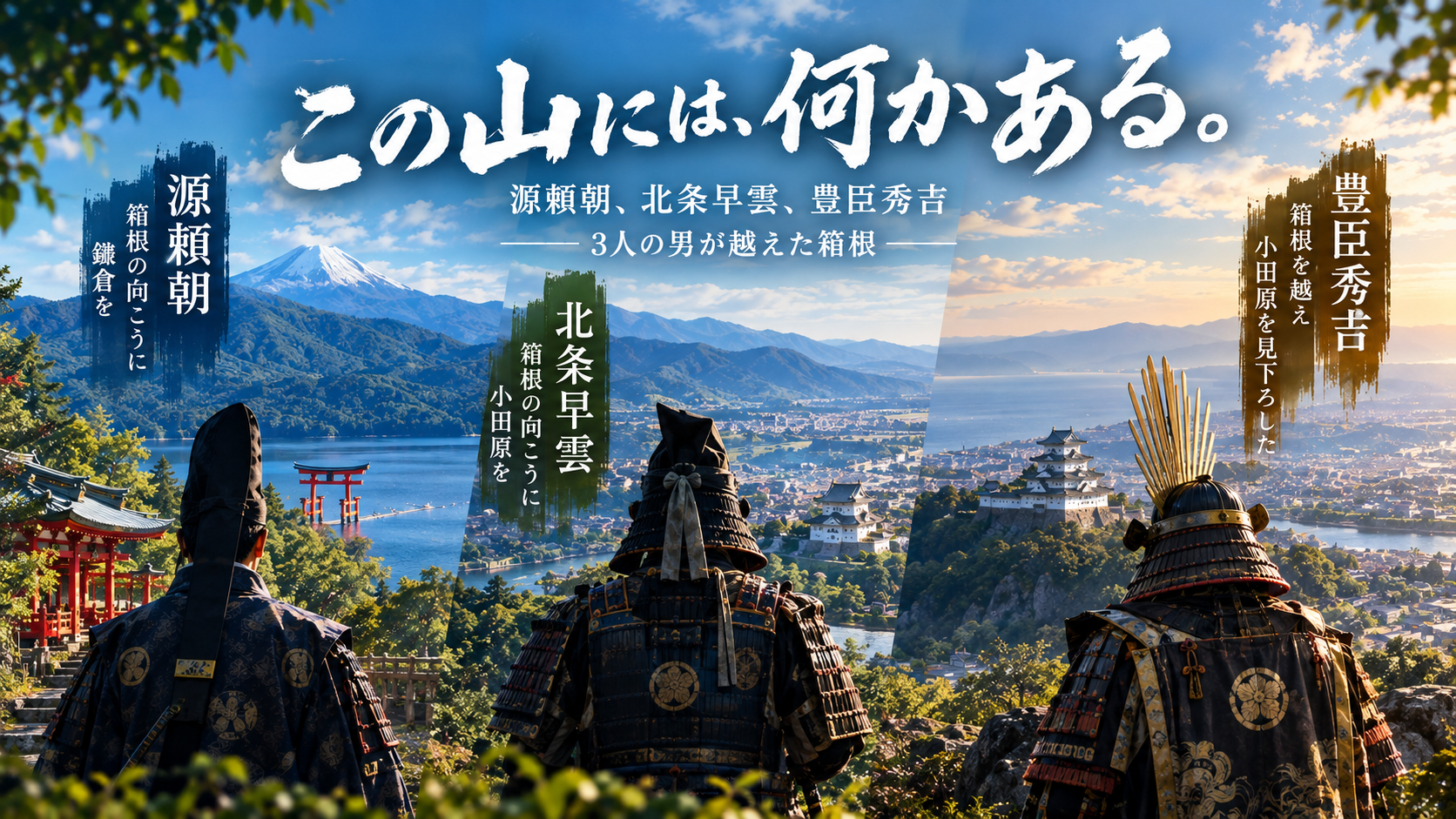
Mount Hakone
The Pass Where Yoritomo Fell, Soun Crossed, and Hideyoshi Looked Down
Today, Hakone can be crossed by train or car in a matter of minutes. But this mountain was once no easy thing to cross. Beyond its steep passes lay Sagami and the town of Odawara, a key checkpoint on the Tokaido highway. And over the centuries, several men who would go on to reshape Japanese history were defeated here, took refuge here, or crossed this very mountain. Minamoto no Yoritomo hid here as a defeated fugitive. Hojo Soun pushed beyond it into Odawara. Toyotomi Hideyoshi crossed it as the final act of unifying the country. Hakone is not just a scenic retreat. Let's walk the pass where history itself once turned.
- Number of spots
- 5 spots
- Travel distance (approx.)
- approx. 26.2km
- Start point
- Ishibashiyama Battlefield
- End point
- Ishigakiyama Castle ("One-Night Castle")
Ishibashiyama Battlefield
神奈川県小田原市石橋
The site where Minamoto no Yoritomo suffered a crushing defeat at the hands of the Taira in 1180. A stone monument marking the battlefield now stands on a quiet hilltop just off Route 135, on the road toward Manazuru and Yugawara — the very direction in which Yoritomo fled.
Our journey begins not at Hakone itself, but just before it, at Ishibashiyama. It was here that Minamoto no Yoritomo suffered a crushing defeat at the hands of the Taira. Before he was anyone of consequence, this is where a beaten Yoritomo first fled for his life into the mountains.
The Battle of Ishibashiyama: Yoritomo's Crushing Defeat
In August 1180, Minamoto no Yoritomo, who had only just raised his banner in Izu, took up a position at Ishibashiyama in Sagami province with barely 300 mounted men. The reinforcements he was counting on from the Miura clan were blocked by a river swollen with rain and never arrived, and Yoritomo's small force found itself pinned front and back by the much larger Taira-allied armies of Oba Kagechika and Ito Sukechika. The result was a defeat that would be remembered for centuries. Yoritomo had no choice but to flee into the mountains with only a handful of men. At this moment he was not yet a shogun or the founder of anything — just the leader of a beaten, scattered band.
Featured in this story: Minamoto no Yoritomo
Next: Hakone Shrine — a bit further out (about 10.6km as the crow flies). Taking a train or bus is recommended
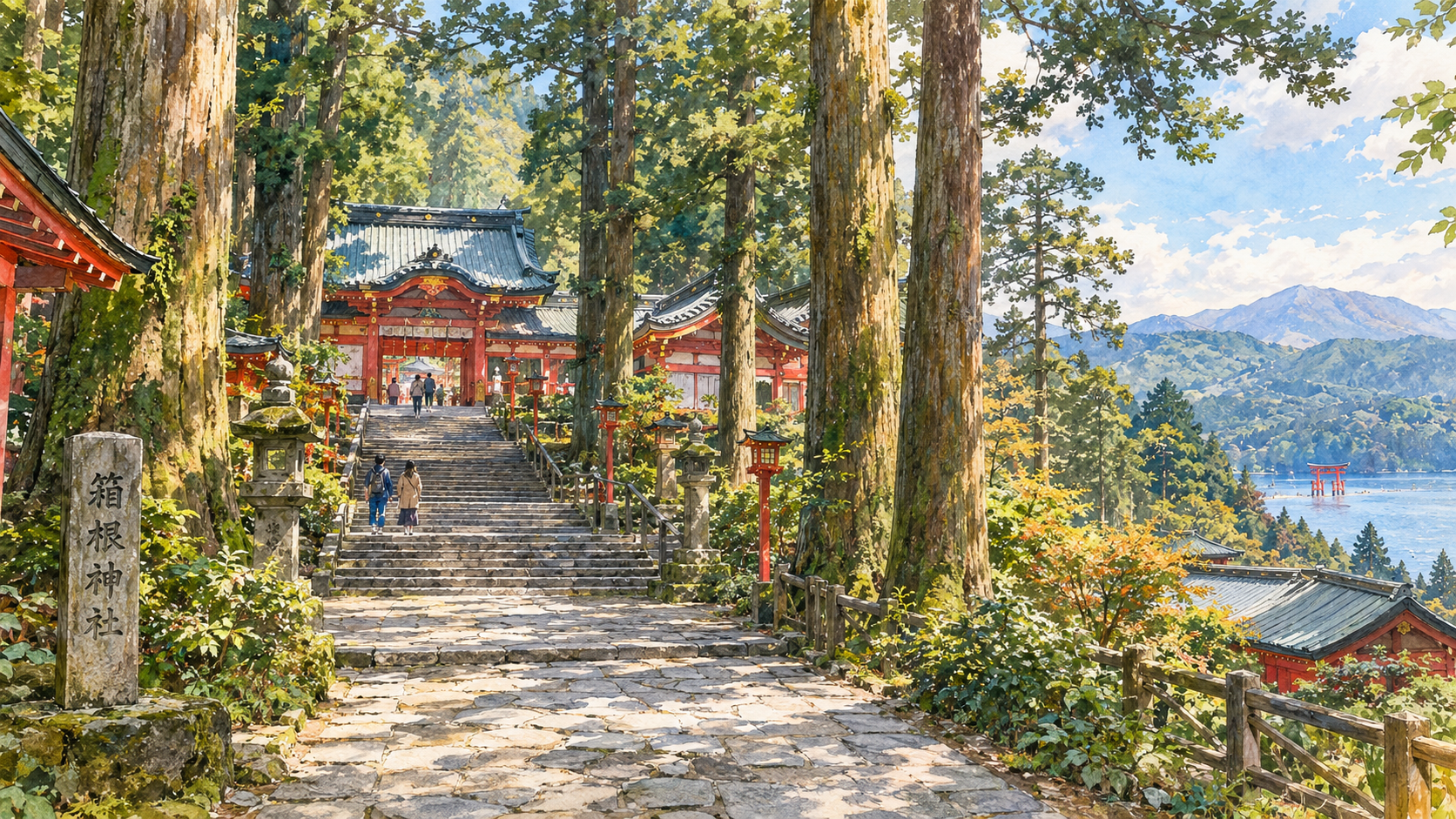
Hakone Shrine
神奈川県足柄下郡箱根町元箱根80-1
An ancient shrine on the shore of Lake Ashi, famous for the vermilion torii gate that appears to float on the water. Visitors climb a cedar-lined approach to reach the main hall. Tradition holds that this shrine sheltered Yoritomo after his defeat at Ishibashiyama, and in the Kamakura period it became one of the two shrines visited on the shogunate's annual "Nisho Mode" pilgrimage.
Leaving Ishibashiyama, we follow Yoritomo into the Hakone mountains, to Hakone Shrine, where he is said to have found shelter. From here he would cross to Awa province and rebuild his forces among the warriors of eastern Japan. This is where a mountain of defeat began its transformation into sacred ground for the shogunate he would go on to found.
Sheltered by Hakone Gongen, and the Origin of the "Nisho Mode"
Having lost at Ishibashiyama, Yoritomo and his remaining followers fled from Toi's cedar-covered hills into the mountains of Hakone. According to the Kamakura shogunate's own chronicle, the Azuma Kagami, it was at this point that Gyojitsu, the head priest of Hakone Gongen (present-day Hakone Shrine), sheltered Yoritomo and helped him evade his pursuers. Yoritomo went on to cross by sea from Manazuru to Awa province, and from there rebuilt his forces. What this mountain came to mean to the shogunate he later founded is best shown by what followed: once the Kamakura shogunate was established, successive shoguns kept up an annual pilgrimage — the "Nisho Mode," or "Visit to the Two Shrines" — to both Hakone Gongen and Izusan Gongen. Gratitude for a mountain that had once sheltered a fugitive became, in time, an official rite of the shogunate.
Featured in this story: Minamoto no Yoritomo
Next: Soun-ji Temple — a bit further out (about 7.6km as the crow flies). Taking a train or bus is recommended
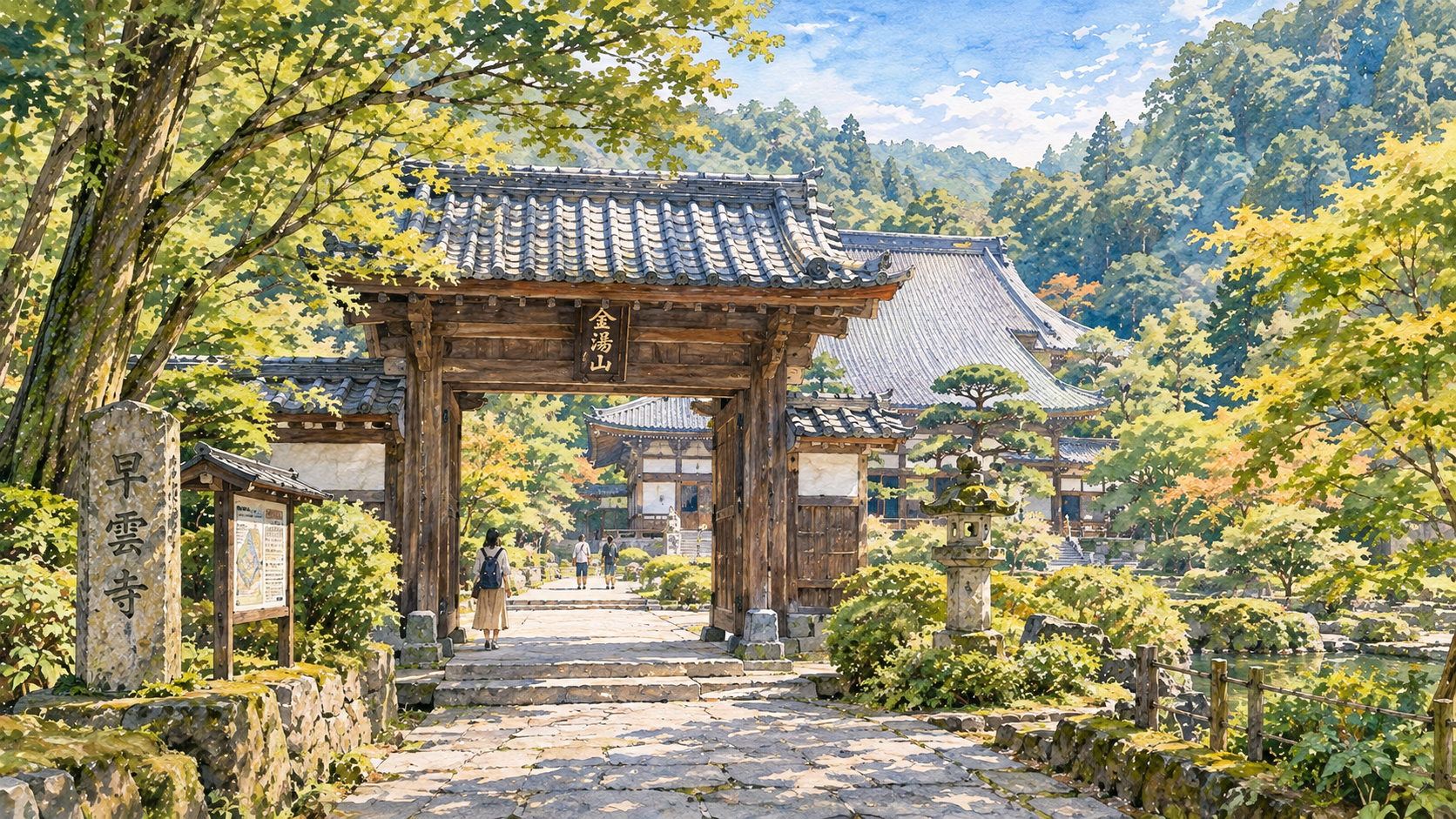
Soun-ji Temple
神奈川県箱根町湯本405
A Rinzai Zen temple on a hillside overlooking the hot-spring town of Hakone-Yumoto, built in 1521 by Hojo Ujitsuna in accordance with the will of his father, Hojo Soun. The temple grounds hold the graves of five generations of Later Hojo lords. During the 1590 siege of Odawara, Toyotomi Hideyoshi made it his headquarters, and the temple was burned as a result.
More than three centuries after Yoritomo's time, another man set his eyes on what lay beyond Hakone: Odawara. His name was Hojo Soun. At Soun-ji, we trace the starting point of the five generations of Later Hojo rule that began once he crossed this mountain.
Ise Moritoki, Crossing to Odawara Beyond the Mountain
More than three centuries after Yoritomo's time, at the dawn of the Sengoku period, a warrior named Ise Moritoki appeared — the man later known as Hojo Soun. He began as a minor guest retainer who had been granted Kokokuji Castle in Suruga province for intervening in a succession dispute within the Imagawa clan, but he went on to bring Izu province under his control and set his sights on Odawara, in Sagami, beyond the Hakone mountains. Odawara was then held by Omori Fujiyori, and sometime around 1495 (scholars still disagree on the exact year), Soun took the castle from him. A famous story claims he won the Omori lord's trust with gifts, then used a deer hunt as a pretext to move troops into the mountains and launch a surprise attack — but this account was compiled generations later, and some historians instead see Soun's advance as one that took advantage of internal discord within the Omori clan. What is certain, in any case, is that Odawara — reached by crossing the Hakone mountains — became the base from which the Later Hojo clan would rule the Kanto region for five generations, roughly a hundred years. Soun himself is buried here at Soun-ji, alongside the graves of the four lords who followed him: Ujitsuna, Ujiyasu, Ujimasa, and Ujinao.
Featured in this story: Hojo Soun
Next: Odawara Castle — a bit further out (about 5.1km as the crow flies). Taking a train or bus is recommended
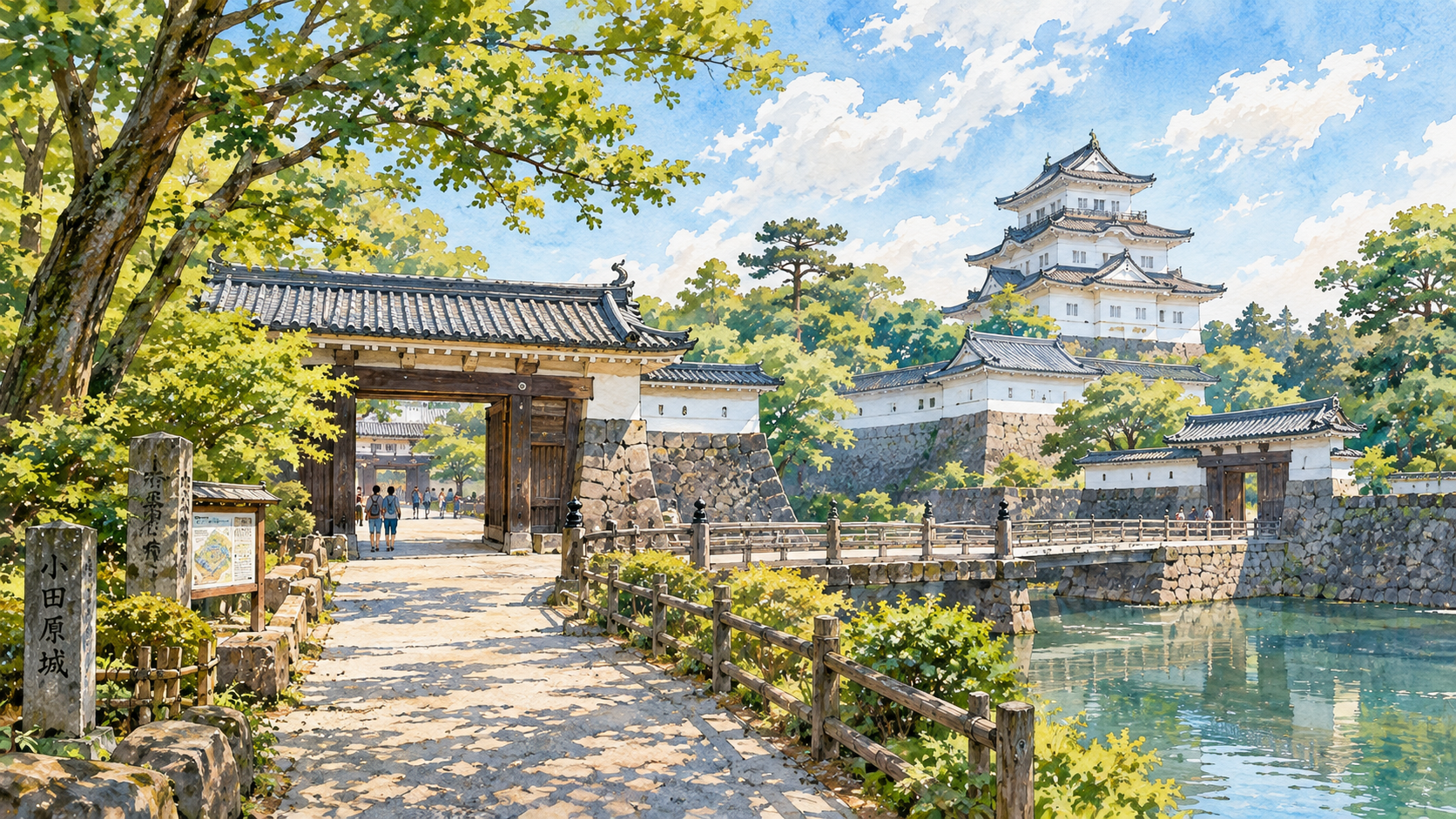
Odawara Castle
神奈川県小田原市城内6-1
The stronghold that anchored five generations of Later Hojo rule after Soun seized it from the Omori clan. Renowned as an "impregnable" fortress that withstood attacks by Uesugi Kenshin and Takeda Shingen, it was surrounded by Hideyoshi's vast army in 1590 and surrendered after roughly three months under siege. The present keep is a 20th-century reconstruction and now houses a museum.
Leaving Soun-ji, we head to Odawara Castle, the base of five generations of Later Hojo rule. This fortress had turned back even Uesugi Kenshin and Takeda Shingen — but now Toyotomi Hideyoshi, already the ruler of Japan in all but name, crosses Hakone to close in on it.
The Impregnable Castle, and the Confrontation With a Man Who Already Ruled Japan
The Odawara Castle that Soun had seized was greatly expanded under his son Ujitsuna and grandson Ujiyasu, becoming one of the strongest fortresses in the Kanto region. It withstood assaults from Uesugi Kenshin and Takeda Shingen, two of the most formidable commanders of the age, and earned a reputation as truly "impregnable." Everything changed in 1590. Toyotomi Hideyoshi, who had already subdued Shikoku and Kyushu and was, in effect, already the ruler of Japan, crossed the Hakone mountains with an army said to number 200,000, determined to bring the Later Hojo — father and son, Ujimasa and Ujinao, the last major power still refusing to submit — to their knees. After roughly three months under siege, Odawara Castle surrendered with barely a fight, and the Later Hojo clan's five generations and roughly hundred years of rule came to an end. For Hideyoshi, the Odawara campaign was not a battle to become the ruler of Japan. It was the last piece he needed to complete a unification he had, for all practical purposes, already achieved.
Featured in this story: Toyotomi Hideyoshi・Hojo Soun
Next: Ishigakiyama Castle ("One-Night Castle") — a bit further out (about 2.9km as the crow flies). Taking a train or bus is recommended
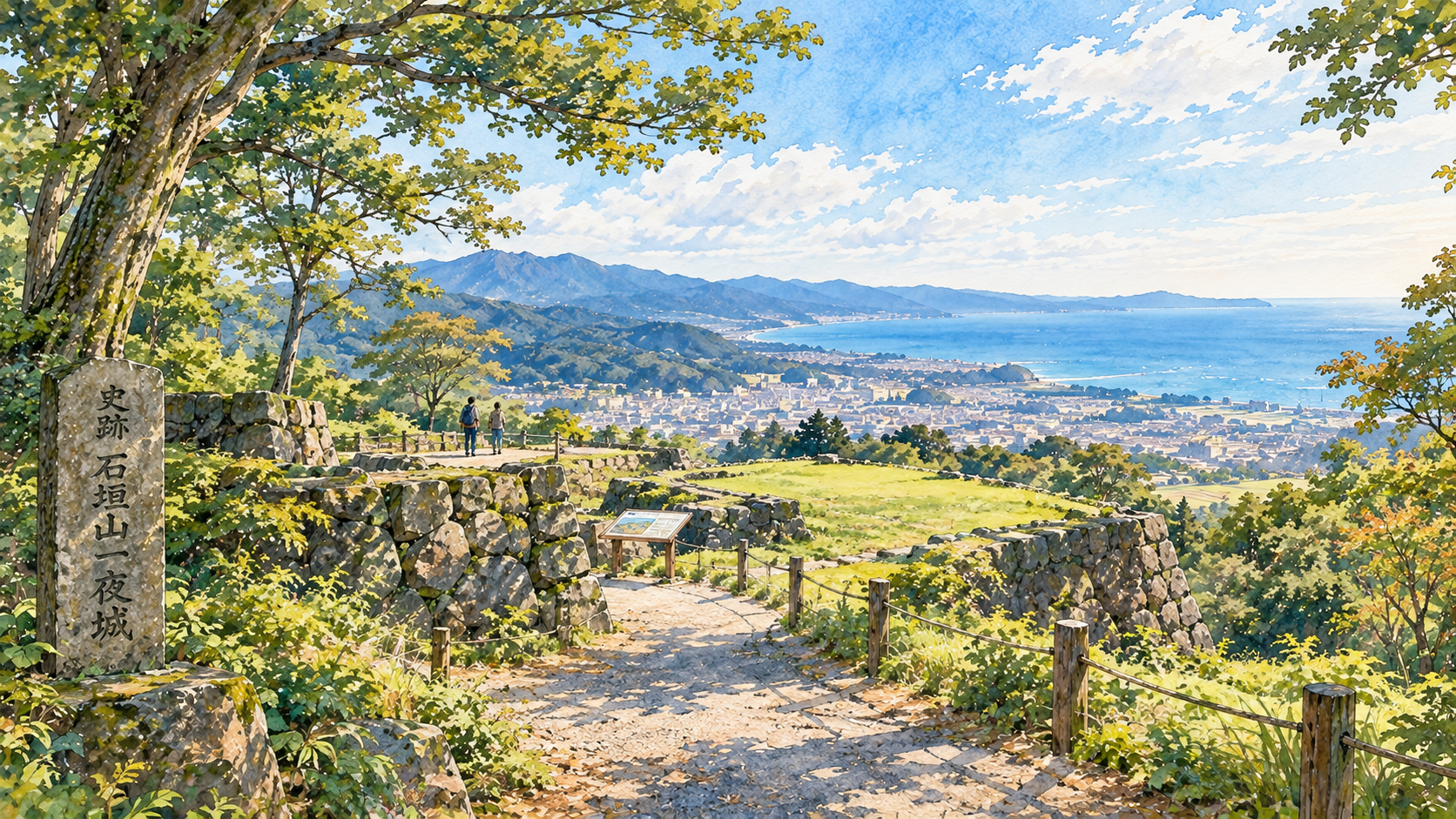
Ishigakiyama Castle ("One-Night Castle")
神奈川県小田原市早川
The ruins of the castle Hideyoshi built as his headquarters for the siege of Odawara. From this 257-meter ridge, the town of Odawara and Sagami Bay beyond spread out below. Despite its nickname, the "One-Night Castle" was not actually built overnight — some 40,000 laborers spent roughly 80 days constructing this stone-walled fortress.
Leaving Odawara Castle, we climb to Ishigakiyama Castle on the facing ridge. Looking down from the castle Hideyoshi built here, the Later Hojo were brought to surrender. The story that began on Mount Hakone reaches its conclusion on this hilltop, overlooking the very moment Japan's unification was completed.
Ishigakiyama, the "One-Night Castle": A Siege Watched From Above
As he laid siege to Odawara Castle, Hideyoshi had a headquarters castle built on Kasakake-yama, the ridge facing it across the valley. Built over roughly 80 days by a workforce of some 40,000, the castle is said to have been deliberately hidden behind the surrounding trees until construction was complete, at which point the trees were felled all at once. To the Hojo defenders watching from Odawara, a castle seemed to have appeared on the mountaintop overnight — the origin of the name "Ishigakiyama Ichiya-jo," the One-Night Castle. It was not, in fact, built in a single night, but the theatrical reveal is said to have badly shaken the defenders' morale. Hideyoshi even summoned Yodo-dono and the tea master Sen no Rikyu here and hosted tea ceremonies, a show of confidence aimed squarely at the castle below. About ten days later, the Later Hojo surrendered. With only the pacification of the Ou region left to complete, Hideyoshi's unification of Japan moved, from this hilltop, toward its effective conclusion.
Featured in this story: Toyotomi Hideyoshi
Mount Hakone Was Never Just a Mountain.
A man defeated here rose again. A man who crossed it came to rule the Kanto region. A man who looked down from it completed the unification of Japan. Walking from Hakone Shrine to Soun-ji, Odawara Castle, and Ishigakiyama Castle, three separate histories converge into a single path across one mountain.
- Before the Mountain, a Man Falls Ishibashiyama Battlefield
- The Mountain That Sheltered a Fugitive, and the Comeback That Followed Hakone Shrine
- Three Hundred Years Later, a Man Set His Sights Beyond the Mountain Soun-ji Temple
- The Impregnable Castle, and the Shadow of a Man Who Already Ruled Japan Odawara Castle
- Looking Down From the Mountain: The End of the Later Hojo Ishigakiyama Castle ("One-Night Castle")
This journey is ready to use in the app
We're sharing a file with all the spots and schedule from this article. Download it and import it from the "Schedule" tab in the Bunny Journey app to take this journey with you.
* If you don't have the app yet, install it from the App Store first.