From Across the Sea, and Then Across the Sea
A Journey Through Northern Kyushu
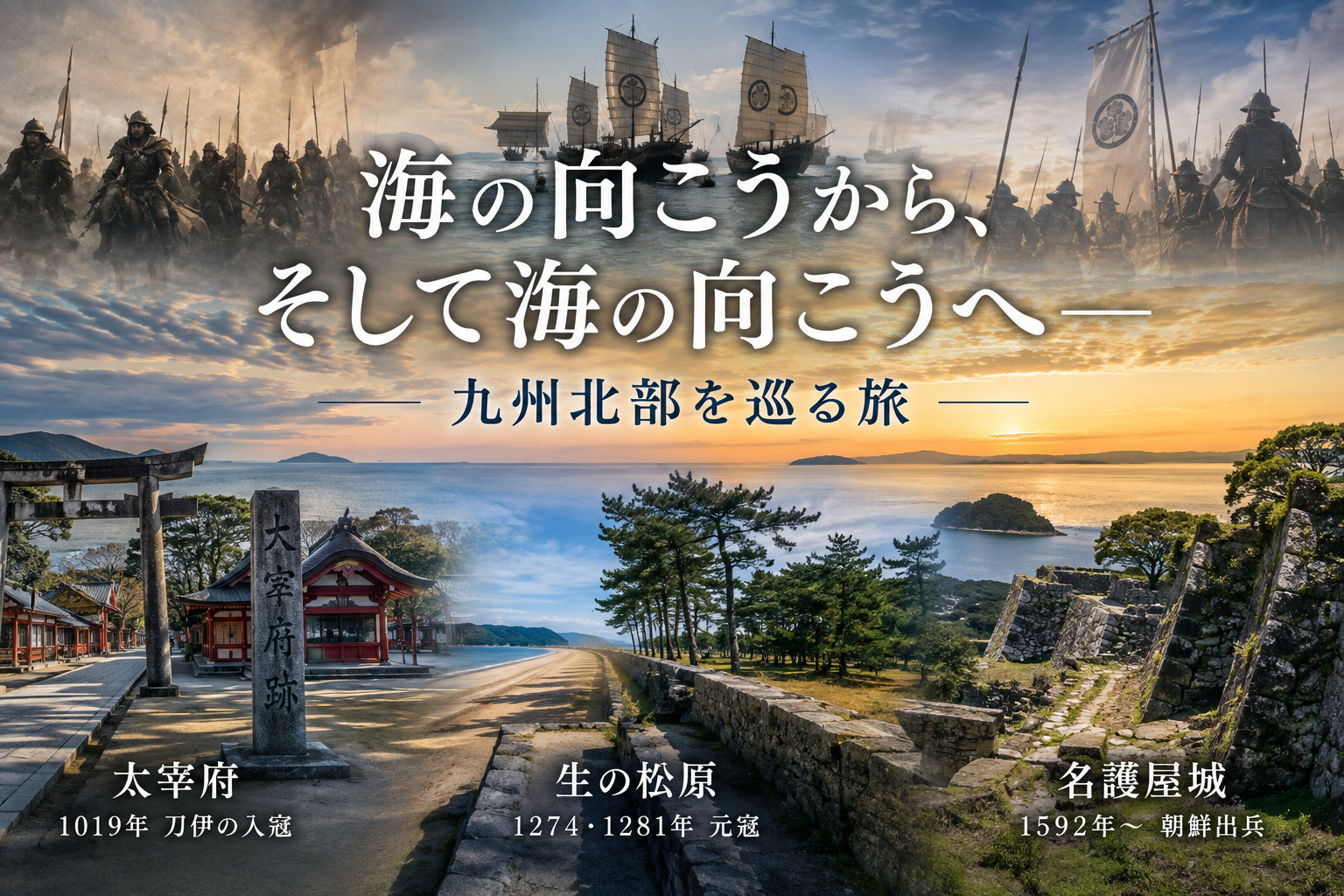
A thousand years ago, an armed group crossed the sea to raid these shores. Two hundred and fifty years later, the army of a vast empire crossed the sea to invade. And three hundred years after that, it was Japan's turn to send a great army across the sea. Northern Kyushu sits at the western edge of Japan — and, at the same time, closer to the world beyond the sea than almost anywhere else in the country. For over a thousand years, this region has stood on the front line, absorbing both the threats that arrived from across the water and the ambitions that later set out across it. Dazaifu, Ikinomatsubara, and Nagoya Castle. Drive from Fukuoka into Saga, and these three places let you experience, as a single journey, the thousand-year story of northern Kyushu — from the Toi invasion of 1019, through the Mongol invasions of 1274 and 1281, to the invasion of Korea that began in 1592.
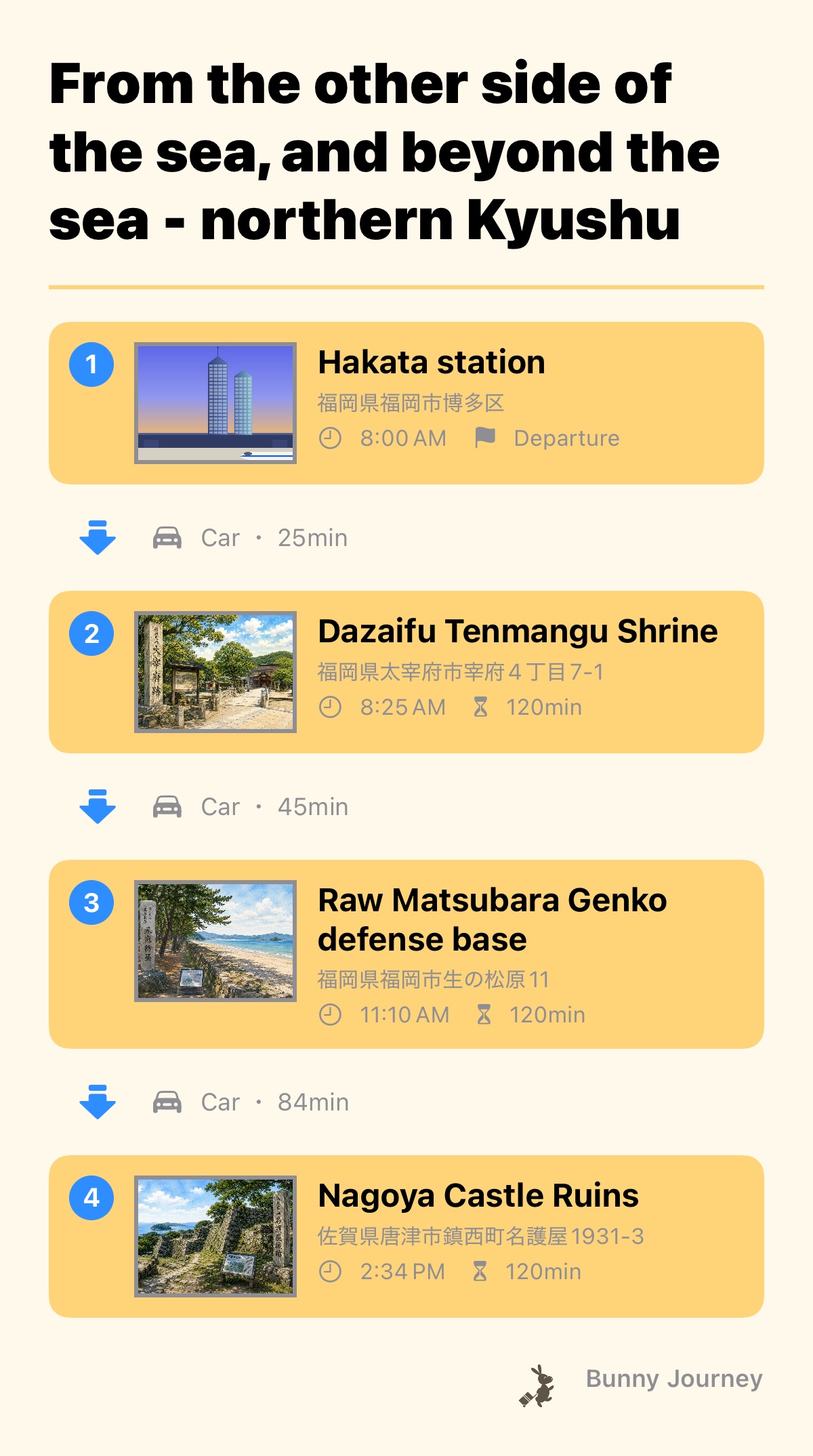
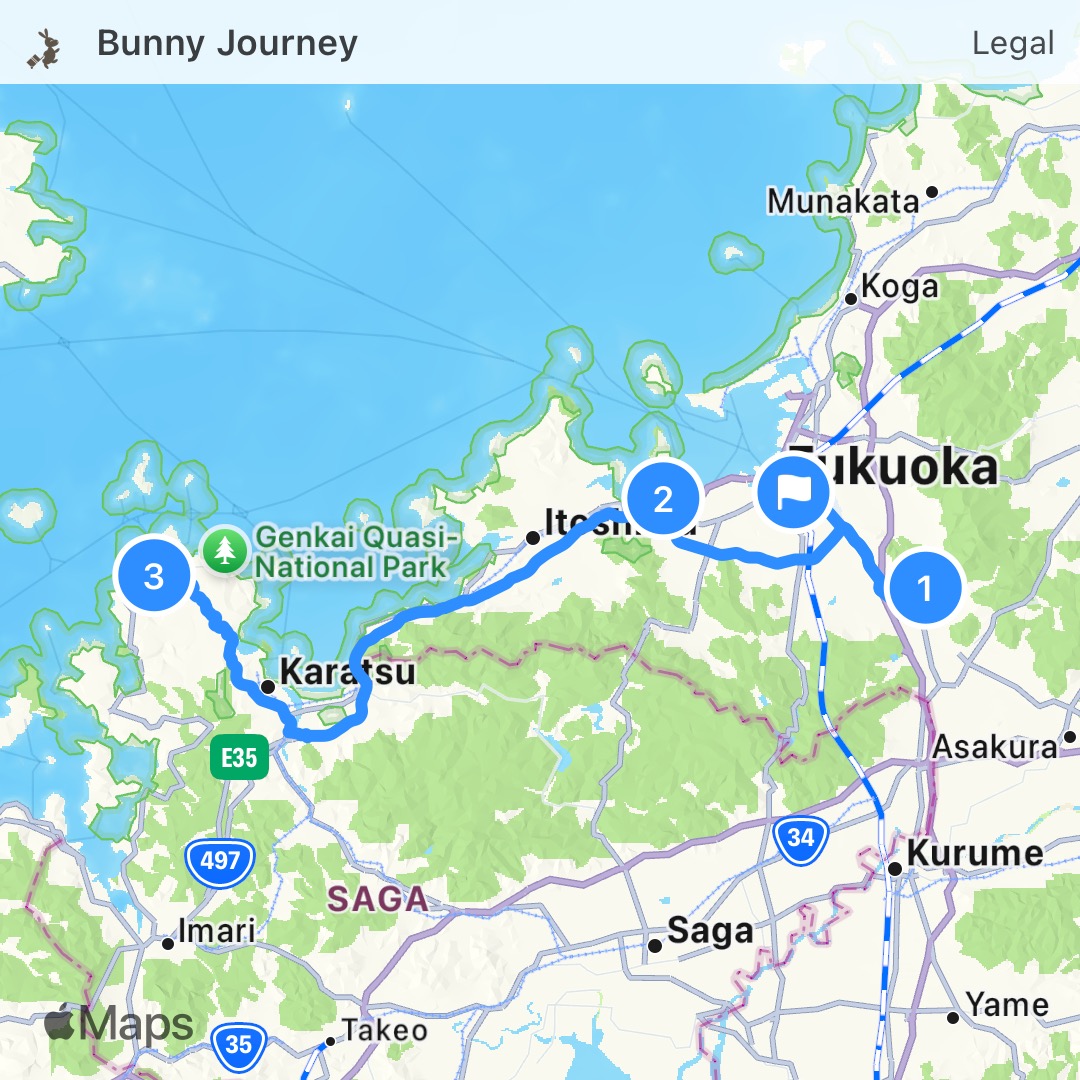
- Number of spots
- 3 spots
- Travel distance (approx.)
- approx. 73.3km
- Start point
- Dazaifu Tenmangu Shrine
- End point
- Nagoya Castle Ruins
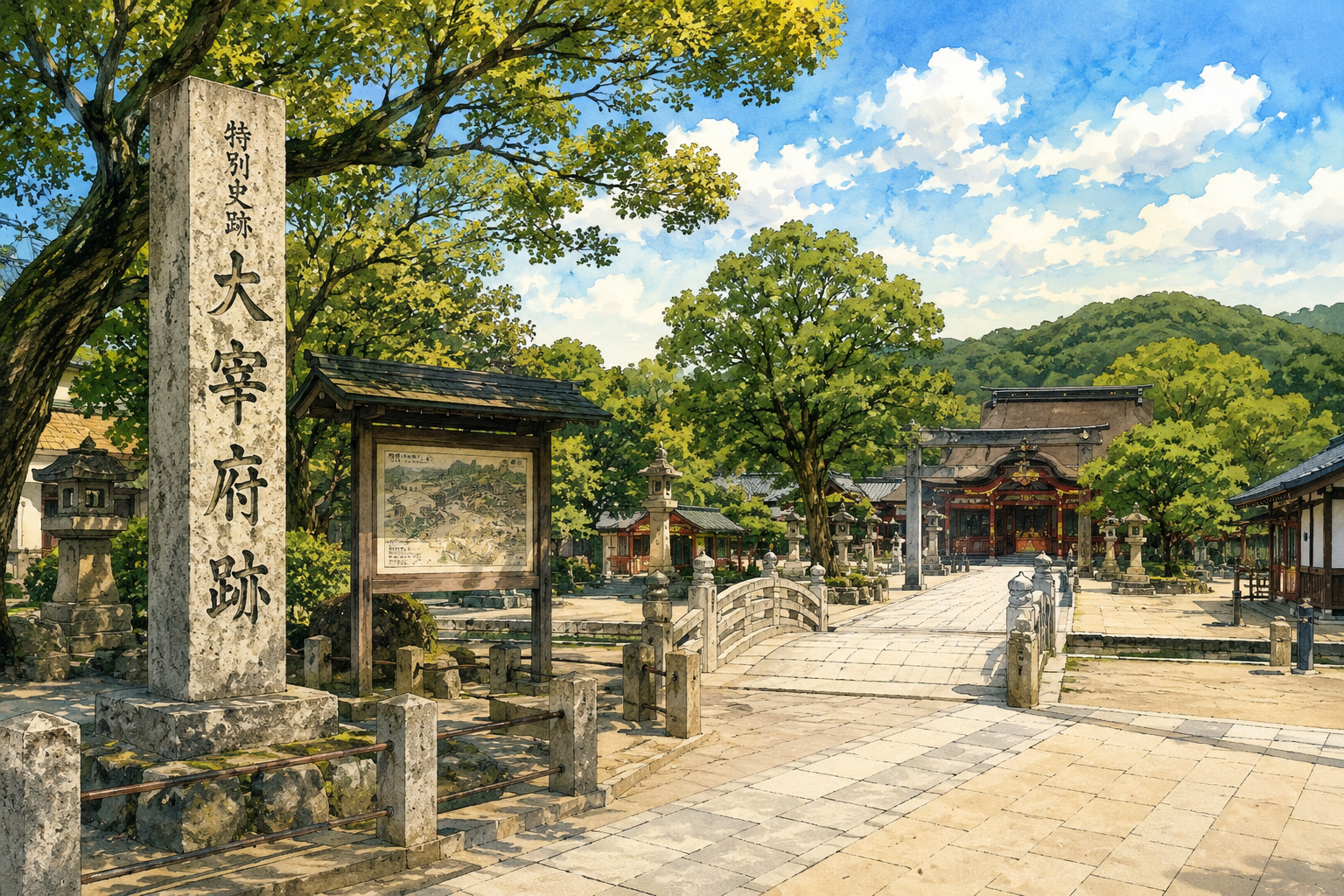
Dazaifu Tenmangu Shrine
福岡県太宰府市宰府4丁目7-1
A shrine dedicated to Sugawara no Michizane, the deity of learning, drawing visitors year-round. A short distance away lie the ruins of the ancient Dazaifu government headquarters, marked by a stone monument reading "Special Historic Site: Dazaifu Ruins" and a quiet historical park recalling the site's role as the administrative, diplomatic, and military center of Kyushu during the Heian period.
Our journey begins at Dazaifu. Its approach lined with souvenir shops and crowded with visitors today, this town was once known as Dazaifu — the administrative, diplomatic, and military stronghold governing all of Kyushu during the Heian period. In 1019, urgent news reached this town: an unfamiliar armed group had struck Tsushima and Iki from across the sea and was closing in on northern Kyushu.
The Toi Invasion: Raiders From Across the Sea
In 1019, an armed group known as the Toi launched a series of attacks on the islands of Tsushima and Iki. The Toi are believed to have been centered on Jurchen peoples, though the makeup of the group as a whole is complex and still debated among historians. On Tsushima and Iki, many islanders were killed, livestock and crops were seized, and a large number of people were abducted. The Toi then pushed on toward Hakata Bay, raiding the coast of northern Kyushu. The attack is thought to have aimed at plunder and abduction rather than the conquest or permanent occupation of Japan — but for Kyushu, it was a threat on a scale never before experienced. Word of the raids reached Dazaifu, where Fujiwara no Takaie, serving as the region's deputy governor-general, took charge of the response. Rallying warrior bands from across Kyushu, he organized a defense that ultimately drove the Toi from Japanese shores. It was precisely because Dazaifu existed as an administrative stronghold that Kyushu was able to mount an organized response to a sudden attack from across the sea.
Featured in this story: Fujiwara no Takaie
Next: Ikinomatsubara Genko Boirui (Mongol Invasion Defense Wall) — a bit further out (about 23.3km as the crow flies). Taking a train or bus is recommended
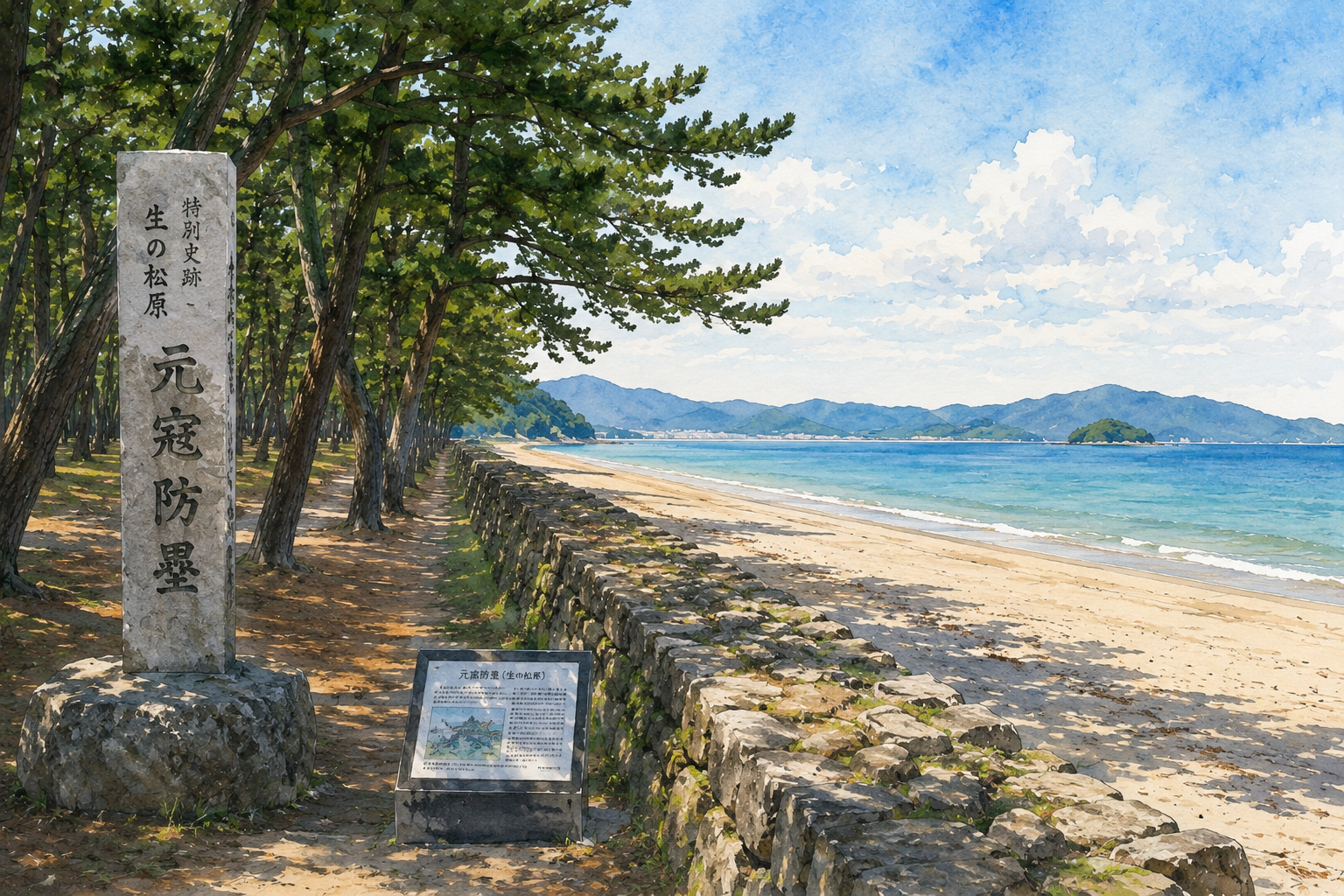
Ikinomatsubara Genko Boirui (Mongol Invasion Defense Wall)
福岡県福岡市西区生の松原
A pine-lined, white-sand beach facing the Genkai Sea. A stone monument reading "Special Historic Site: Ikinomatsubara Genko Boirui" stands among the pines, and the remains of a stone defensive wall still line the shore. Looking out to sea through the pines, it's easy to picture the fleet that once approached from beyond the horizon, more than 700 years ago.
Leaving Dazaifu, it's about a 45-minute drive to our next stop: Ikinomatsubara, on the western shore of Hakata Bay. Many people first discovered the history of Tsushima and the Mongol invasions through the game Ghost of Tsushima. That story began on Tsushima — but the Mongol fleet's real objective lay further on, in Hakata Bay itself. Looking out at the sea beyond the pines, follow the history south from Tsushima to this shore.
The Mongol Invasions: An Empire Crosses the Sea
A little more than 250 years after the Toi invasion, in 1274, Japan faced a threat on an entirely different scale. The Mongol Empire, which by then controlled much of Eurasia, launched an invasion of Japan together with forces from Goryeo (the Battle of Bun'ei). After subduing Tsushima and Iki, the Mongol fleet pushed on to Hakata Bay, where fierce fighting with Kyushu's warrior bands ultimately forced a withdrawal. The Mongols continued to demand Japan's submission, and in 1281 they sent an even larger force in a second invasion (the Battle of Koan). In the years between the two invasions, the Kamakura shogunate and Kyushu's warriors built a stone wall along the shore of Hakata Bay to block any landing. The Genko Boirui that still stands today at Ikinomatsubara is a surviving section of that wall. During the 1281 invasion, this wall significantly hindered the Mongols' attempt to land, forcing their fleet into a prolonged standoff at sea — a standoff that ended, with a storm also playing a part, in their retreat. Where the Toi invasion had been a defensive battle fought by Kyushu alone, the Mongol invasions became a national defense effort involving the entire Kamakura shogunate.
Featured in this story: Hojo Tokimune
Next: Nagoya Castle Ruins — a bit further out (about 50.0km as the crow flies). Taking a train or bus is recommended
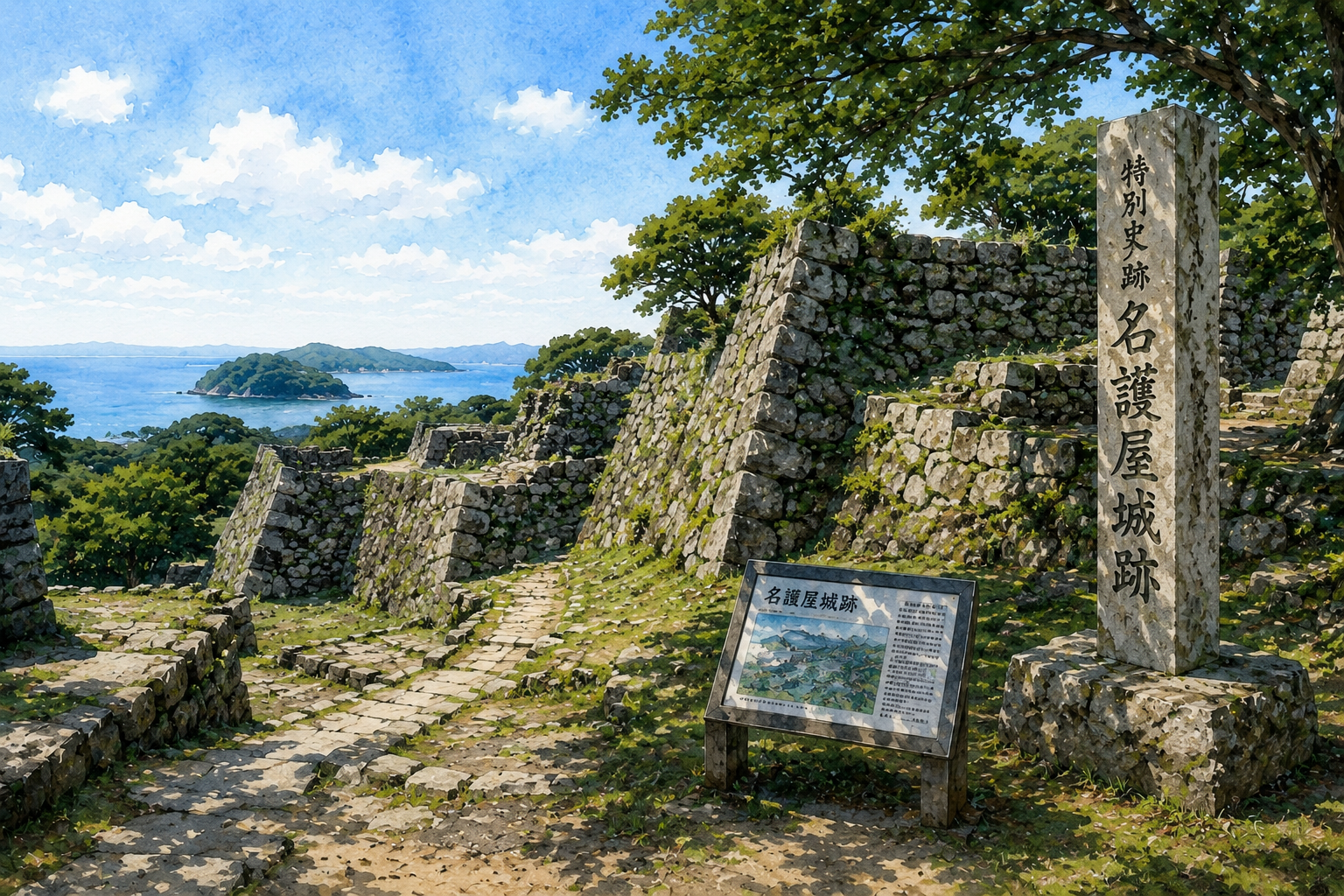
Nagoya Castle Ruins
佐賀県唐津市鎮西町名護屋1931-3
The ruins of a castle built on a hilltop overlooking the Genkai Sea. Alongside a stone monument reading "Special Historic Site: Nagoya Castle Ruins" and information boards, sweeping stone walls remain throughout the site, hinting at its former scale. Beyond the trees, the sea stretches toward the Korean Peninsula, once crossed by a great army.
Leaving Ikinomatsubara, we drive to Karatsu, Saga Prefecture — about 84 minutes away. At the end of that drive lies Nagoya Castle, where the direction of this history reverses. Both the Toi invasion and the Mongol invasions were threats that came toward Japan from across the sea. But starting in 1592, it was Japan's turn to send a great army in the opposite direction — and Nagoya Castle was the forward base from which it departed.
The Invasion of Korea: This Time, Japan Crosses the Sea
A little over 300 years after the Mongol invasions, in 1590, Toyotomi Hideyoshi defeated the Hojo clan and completed the unification of Japan. Now the country's supreme ruler, Hideyoshi turned his ambitions toward the conquest of Ming China, and as a first step, ordered an invasion of the Korean peninsula. In 1592, Nagoya Castle was built on this site facing the Genkai Sea to serve as the staging base for the campaign. At its completion, Nagoya Castle is said to have rivaled Osaka Castle in scale, and more than a hundred camps belonging to daimyo from across the country sprang up around it — for a time, the area is said to have swelled into a vast camp town housing several hundred thousand people. From here, a great army crossed the sea toward the Korean peninsula (the Bunroku campaign). As the fighting stalled, a temporary truce and negotiations followed, but when talks broke down, a second invasion was launched in 1597 (the Keicho campaign); Japanese forces withdrew only after Hideyoshi's death in 1598. Having twice turned back threats that came from across the sea — first the Toi, then the Mongols — northern Kyushu now became the departure point for a great army crossing the sea in the opposite direction. Today, the ruins of Nagoya Castle preserve stone walls including the base of its former main keep, and from the hilltop overlooking the Genkai Sea, visitors can still gaze out at the very waters that once carried a great army toward the Asian mainland.
Featured in this story: Toyotomi Hideyoshi
A Thousand Years From Across the Sea, Then Three Hundred Years Back Across It.
Northern Kyushu twice turned back threats that came from across the sea — the Toi, then the Mongol Empire. Three hundred years later, under Toyotomi Hideyoshi, it became the launching point for a great army crossing the sea in the opposite direction. Drive from Dazaifu to Ikinomatsubara to Nagoya Castle, and you can feel the exact moment that direction reverses.
- 1,000 Years Ago, Raiders Came From Across the Sea Dazaifu Tenmangu Shrine
- 250 Years Later, an Empire's Army Crossed the Sea Ikinomatsubara Genko Boirui (Mongol Invasion Defense Wall)
- 300 Years Later, This Time Japan Crossed the Sea Nagoya Castle Ruins
This journey is ready to use in the app
We're sharing a file with all the spots and schedule from this article. Download it and import it from the "Schedule" tab in the Bunny Journey app to take this journey with you.
* If you don't have the app yet, install it from the App Store first.